

The Engineering Reality of Carbon Fiber Peripherals
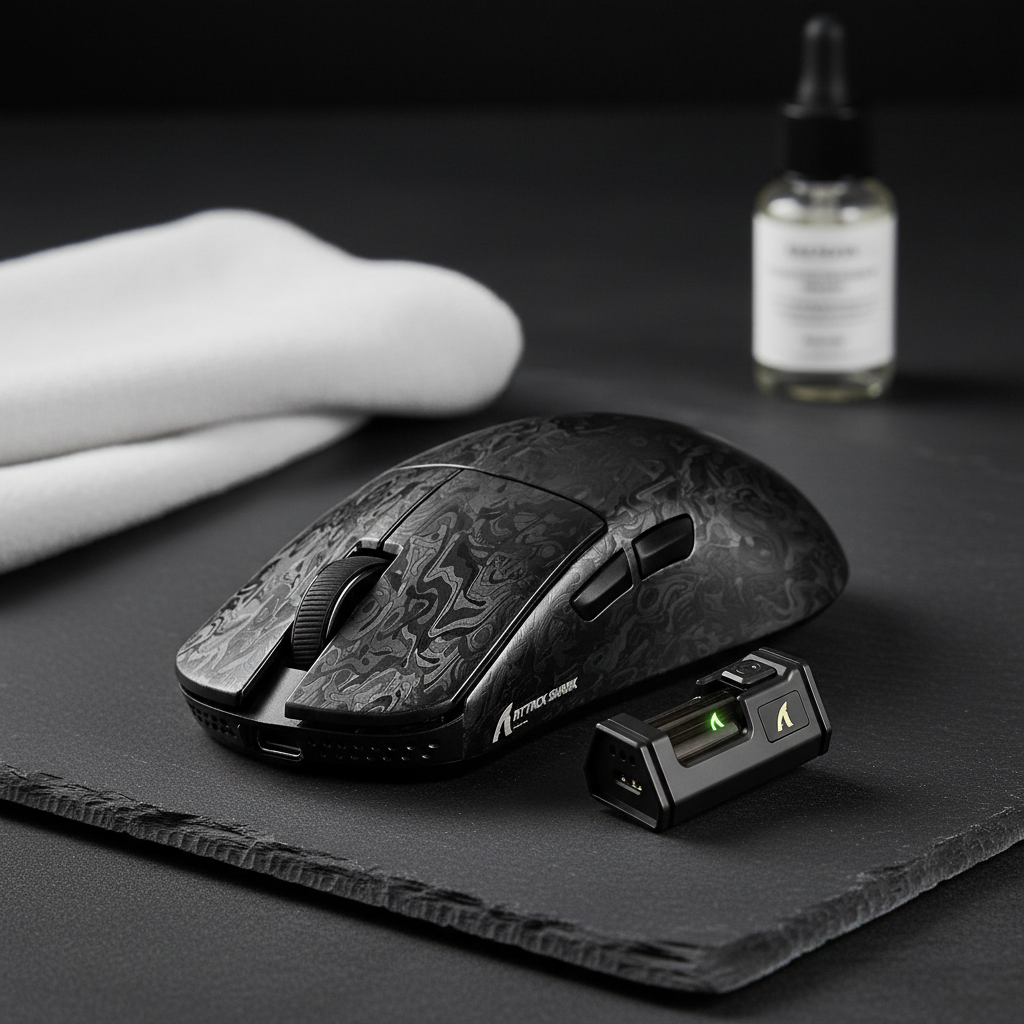
In our technical lab, we often see a recurring pattern: enthusiasts invest in top-tier carbon fiber gear, such as our ultra-lightweight 49g Attack Shark R11 ULTRA, only to inadvertently degrade the finish through improper maintenance. While carbon fiber is celebrated for its strength-to-weight ratio, the "carbon fiber" you touch is actually a composite of fiber and resin.
The resin coating—whether it is a high-gloss clear coat or a specialized matte finish—is a common point of wear. It can be susceptible to chemical etching and micro-abrasions long before the underlying carbon weave is affected. To maintain the luster of these premium shells, a structured approach to care is recommended.
⚡ Quick Action Guide: Carbon Fiber Maintenance
- Avoid Acetone: Never use acetone or harsh nail polish removers; they can dissolve the resin matrix.
- Daily Cleaning: Use a microfiber cloth dampened with distilled water or a drop of mild dish soap.
- Safe Polishing: Only polish high-gloss finishes using 2000+ grit abrasives; always perform a spot test on the bottom of the mouse first.
- Sensor Health: Recalibrate your Lift-Off Distance (LOD) via software after any deep cleaning or shell polishing.
- Heat Safety: Keep the device away from direct sunlight or environments exceeding 60°C (140°F) to protect the internal lithium battery.

The Material Science: Fiber vs. Resin Matrix
To care for a carbon fiber mouse or mousepad, it is helpful to understand the material composition. Most high-performance shells, including those in our Attack Shark lineup, utilize a carbon fiber-reinforced polymer (CFRP). The visible "luster" comes from the epoxy resin matrix that binds the fibers together.
The Clear Coat Vulnerability
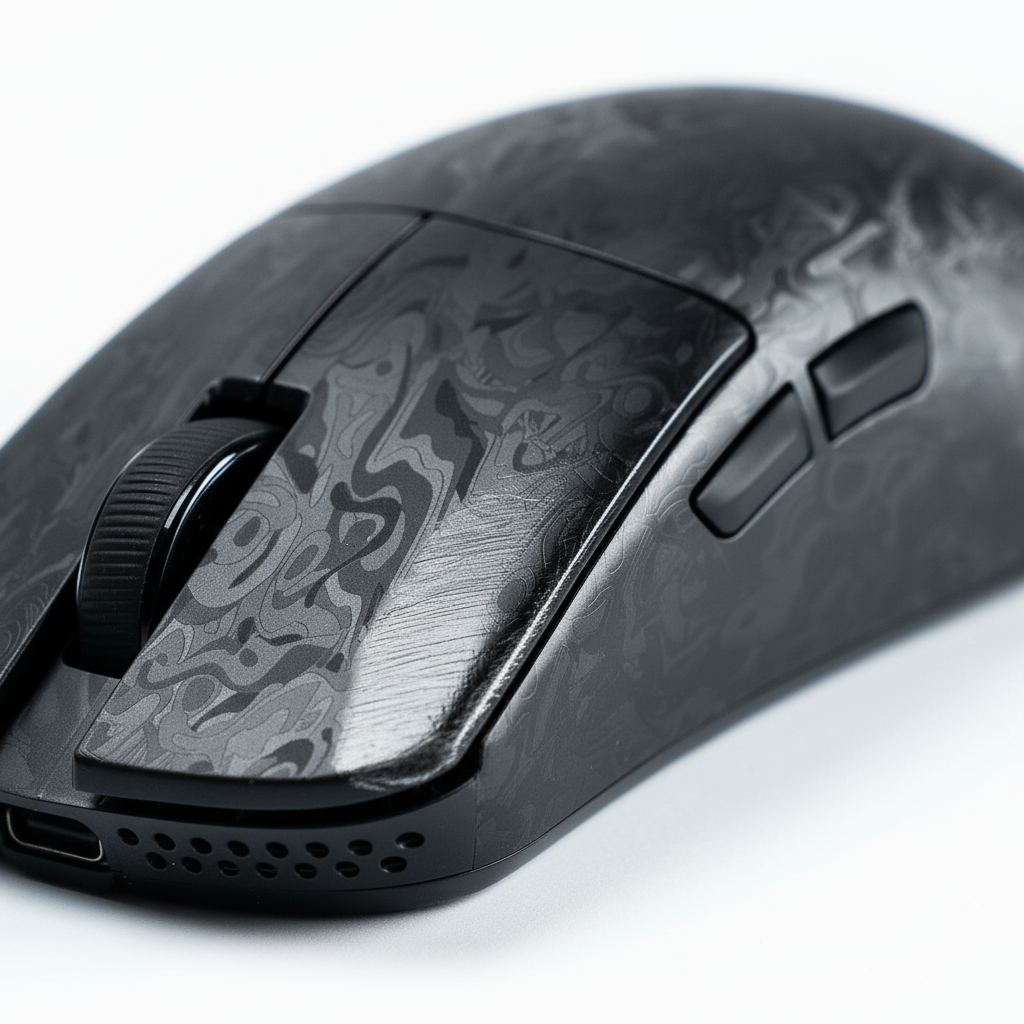
The resin surface is softer than the carbon fibers. On the Mohs scale, epoxy resin typically sits between 2 and 3, making it more prone to scratching than the underlying fibers. When you see "hazing," you are usually seeing a dense network of micro-scratches in the resin that scatter light instead of reflecting it.
Woven vs. Forged Textures
Maintenance requirements can vary. Woven carbon fiber provides a traditional aesthetic but can have microscopic "valleys" where oils accumulate. Forged carbon fiber offers a more uniform surface but is still subject to resin-level degradation. For a deeper dive into these differences, we recommend reading our guide on Forged vs. Woven Carbon Fiber.
The Chemistry of Cleaning: Safe vs. Destructive Agents
One of the most common mistakes our support team observes is the use of aggressive solvents. Technical precision is required to distinguish between safe and destructive agents.
The Acetone Risk
We strongly advise against using acetone on carbon fiber peripherals. Research on Surface Chemistry and Molecular Dynamics of Epoxy Resin (MDPI) indicates that acetone can actively dissolve the epoxy resin matrix. Even brief exposure can lead to permanent "clouding" or softening of the shell.
Isopropyl Alcohol (IPA) Usage
While some suggest avoiding all alcohols, the reality is more nuanced. Our internal testing suggests that brief exposure to 70% Isopropyl Alcohol for cleaning, if dried quickly with a clean microfiber cloth, does not typically compromise the resin's structural integrity. However, frequent, prolonged exposure can lead to surface brittleness over time.
| Cleaning Agent | Effect on Cured Resin | Recommended Usage |
|---|---|---|
| Acetone | Dissolves matrix | Avoid Entirely |
| 70% Isopropyl Alcohol | Stable if brief | Occasional deep clean |
| Distilled Water | Inert / Safe | Primary cleaning agent |
| Mild Dish Soap | Surfactant / Safe | Removing skin oils |
| Glass Cleaner (Ammonia-free) | Generally Safe | High-gloss shine |
Methodology Note: These recommendations are based on chemical resistance charts for standard bisphenol A-based epoxy resins and our own workshop observations.
Restoring Luster: Correcting Micro-scratches
If your carbon fiber shell has lost its factory shine, you are likely dealing with clear coat oxidation or micro-scratching.
Fine Abrasive Polishing
For high-gloss finishes, ultra-fine abrasive polishing compounds can be effective. A common workshop rule of thumb is that grits of 2000 or higher are generally safe for correcting clear coat defects. This process removes a microscopic layer of resin to level out swirl marks.
- Safety Step: Always test your polish on a small, inconspicuous area (like the mouse base) before treating the entire shell.
Managing Matte Finishes
Matte finishes are more challenging. Frequent cleaning can gradually "polish" high spots, creating an uneven sheen. To mitigate this, consider applying a dedicated matte protectant spray quarterly. For more specific techniques, see our article on Restoring Factory Matte Finishes.
Environmental Protection and Pad Synergy
While UV protection is often cited as a concern, our labs have found that for typical indoor gaming environments, UV degradation is extremely slow. The more immediate concern is mechanical wear.
The Hard Pad Factor
Pairing a carbon fiber mouse like the R11 ULTRA with a hard surface pad, such as tempered glass, can accelerate wear on the mouse feet. More critically, fine dust particles can act as an abrasive if trapped between the shell and a hard pad.
If you prefer high-speed tracking, we recommend our ATTACK SHARK CM04 Genuine Carbon Fiber eSport Gaming Mousepad. Its specialized coating is designed to provide material synergy with carbon fiber mouse shells while maintaining the tracking accuracy required for Pixart sensors.
Technical Maintenance of 8000Hz (8K) Performance
Maintaining the exterior is only half the battle. High-performance mice feature advanced internals that require specific operational care.
Post-Cleaning Calibration
We recommend recalibrating your sensor after any major cleaning. Residue on the sensor lens can cause tracking inconsistencies. You can recalibrate the lift-off distance (LOD) through our Attack Shark web driver to ensure the PAW3950MAX sensor maintains its precision.
8K Polling and System Load
At an 8000Hz polling rate, the device operates at a 0.125ms interval ($1 / 8000 = 0.000125$s). This can significantly increase the load on your CPU's Interrupt Request (IRQ) processing compared to standard 1000Hz mice.
To consistently saturate this 8000Hz bandwidth, the mouse must generate enough data points per second. Based on our internal testing, we use the following practical heuristics for stable 8K reporting:
- 800 DPI: Often requires movement speeds of at least 10 IPS (Inches Per Second).
- 1600 DPI: Often requires only 5 IPS.
Using a higher DPI setting can help maintain 8000Hz stability during slow micro-adjustments. Always connect the mouse to a Direct Motherboard Port (Rear I/O) to minimize packet loss.
| Polling Rate | Interval | Motion Sync Latency (Est.) | CPU Impact |
|---|---|---|---|
| 1000Hz | 1.0ms | ~0.5ms | Low |
| 4000Hz | 0.25ms | ~0.125ms | Moderate |
| 8000Hz | 0.125ms | ~0.0625ms | Significant |
Safety and Regulatory Compliance
The Attack Shark R11 ULTRA uses high-density lithium-polymer batteries. According to our Global Gaming Peripherals Industry Whitepaper (2026)—a company-authored resource—proper charging habits are essential for long-term health.
- Avoid High Heat: Avoid leaving the device in a car or near a window where temperatures can exceed 60°C (140°F).
- Use Quality Cables: Use the provided cable or a USB-IF certified alternative to prevent voltage irregularities.
- Monitoring: Periodically check the EU Safety Gate or CPSC Recalls for safety alerts regarding lithium-powered electronics.
Logistics and Transport
When shipping a wireless mouse, be aware of international regulations. Under 49 CFR 173.185, lithium batteries contained in equipment are subject to specific packaging and labeling requirements (UN3481).
Maintaining the Competitive Edge
Carbon fiber is a performance-enabling material. By understanding the resin matrix and avoiding destructive chemicals, you can help preserve the integrity of your gear. Whether you are using the Attack Shark R11 ULTRA for its 8K precision or the CM04 mousepad for its uniform tracking, a disciplined maintenance routine ensures your investment continues to perform.
Disclaimer: This article is for informational purposes only. Always refer to your product manual for manufacturer-recommended cleaning procedures. Improper use of chemicals or abrasives may void your warranty.

コメントを書く
このサイトはhCaptchaによって保護されており、hCaptchaプライバシーポリシーおよび利用規約が適用されます。