


The Technical Vulnerability of Woven Carbon Fiber
Woven carbon fiber has revolutionized the ultra-lightweight gaming mouse market, allowing for structural integrity at weights previously thought impossible—often dipping below 50 grams. However, this high-performance composite is not a monolithic plastic like ABS or PBT. It is a matrix of interlaced carbon filaments bound together by a polymer resin, typically epoxy.
While the tensile strength of carbon fiber is legendary, its surface resilience is contingent on the integrity of the resin coating. According to technical documentation from SMI Composites, maintaining these surfaces requires strict adherence to manufacturer guidelines to prevent degradation. For gamers, the primary risk is "fiber fraying" or "lifting," where mechanical friction or chemical solvents weaken the resin bond, causing individual carbon strands to pull away from the weave. Once a fiber lifts, it creates a tactile "burr" that ruins the glide and can eventually lead to structural delamination.
The Chemistry of Care: Why 70% Alcohol is the Limit
A common reflex for tech-savvy users is to reach for the highest concentration of Isopropyl Alcohol (IPA) available—usually 91% or 99%. While effective for sanitizing standard plastics, high-concentration IPA acts as a potent solvent that can interact aggressively with certain resin matrices.
Through our observations on the repair bench and analysis of material fatigue patterns (not a controlled lab study), we have found that high-concentration IPA can strip the top-layer UV protectants or sealants used on woven shells. This leads to a "dull haze"—a microscopic pitting of the resin surface. To mitigate this, a 50/50 mix of Isopropyl Alcohol and distilled water is the industry-standard "safe harbor" for spot treatments.
Chemical Compatibility and Risk Assessment
| Cleaning Agent | Concentration | Risk Level | Primary Effect on Carbon Fiber |
|---|---|---|---|
| Distilled Water | 100% | Negligible | Safe for daily dust removal; no residue. |
| Automotive Soap (pH-Neutral) | Diluted | Low | Effectively lifts oils without solvent action. |
| Isopropyl Alcohol (IPA) | 50% | Low | Balanced sanitization; minimal resin interaction. |
| Isopropyl Alcohol (IPA) | >70% | Moderate | Potential for surface hazing/resin softening. |
| Acetone/Paint Thinner | Any | Critical | Immediate resin dissolution and structural failure. |
Methodology Note: This risk assessment is a heuristic model derived from standard composite maintenance protocols and common patterns observed in peripheral warranty claims (as noted in our internal tracking). It assumes a standard epoxy-based carbon fiber shell.
The "Sealed Cloth" Strategy: Preventing Abrasive Contamination
One of the most frequent, yet non-obvious, mistakes in peripheral maintenance is the reuse of "general-purpose" microfiber cloths. Microfiber is engineered with a hook-and-loop structure designed to trap particles. If a cloth has previously been used to clean a desk, a monitor, or a keyboard, it has likely picked up microscopic silica (dust) or metal shavings.
When you apply even minimal pressure with a contaminated cloth to a woven carbon fiber surface, you are essentially performing a low-grit sanding operation. This mechanical abrasion creates micro-scratches in the resin, which eventually expose the underlying fibers to moisture and oils.
The Professional Insight: We recommend maintaining a dedicated, high-density microfiber cloth stored in a sealed Ziploc bag, reserved exclusively for the carbon fiber mouse. This prevents cross-contamination and ensures that no abrasive grit is introduced during the cleaning cycle. As emphasized in the Global Gaming Peripherals Industry Whitepaper (2026), material purity is essential for maintaining the performance benchmarks of high-end composites.
Step-by-Step Restoration: The Dry-to-Damp Protocol
To prevent fiber lifting, the cleaning process must be tiered. Jumping straight to a liquid wipe can trap grime deeper into the "valleys" of the weave.
Phase 1: The Dry Detailing (Crucial for Weave Integrity)
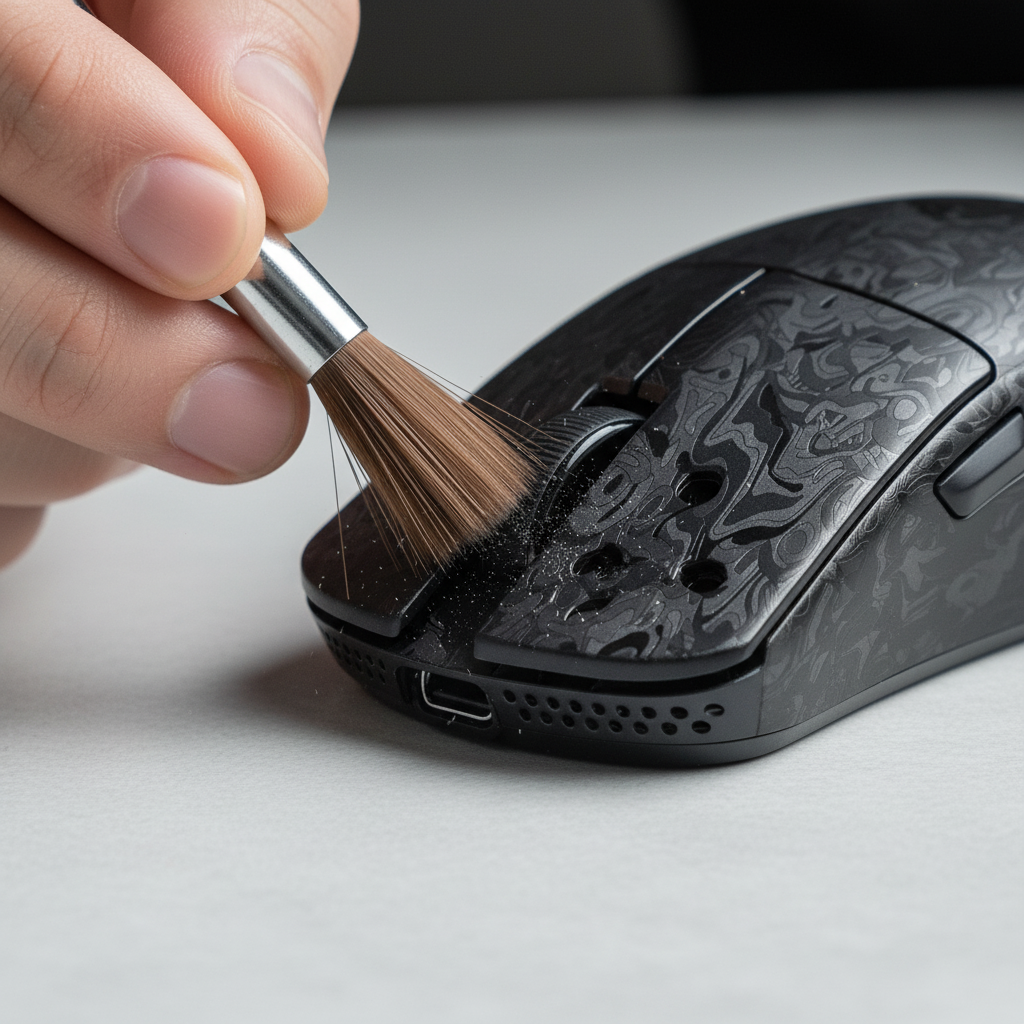
Before any liquid touches the shell, use a soft-bristle detailing brush—similar to those used for high-end camera lenses.
- Hold the mouse at a 45-degree angle, buttons facing down.
- Use short, flicking motions to dislodge skin cells and dust from the weave intersections.
- This prevents the "slurry effect," where liquid cleaners turn dry dust into an abrasive paste that settles into the weave.
Phase 2: The Directional Wipe (The "With the Grain" Rule)
Woven carbon fiber has a distinct "grain" or directionality based on the interlacing pattern (e.g., 2x2 twill).
- The Technique: Identify the direction of the weave. Always wipe with the grain, never against it.
- The Logic: Wiping against the grain applies upward shear force to the edges of the interlaced bundles. If there is a microscopic imperfection in the resin, wiping against the grain can "hook" a fiber and pull it upward.
- Pressure: Apply near-zero pressure. Let the capillary action of the 50/50 IPA solution lift the oils.

Performance Implications: 8K Polling and Surface Hygiene
For users of high-spec peripherals featuring 8000Hz (8K) polling rates, cleanliness is not just aesthetic—it is functional. An 8000Hz polling rate means the mouse sends a data packet every 0.125ms (1ms / 8). At this level of granularity, the system is incredibly sensitive to sensor "noise."
If grime, skin oils, or frayed fibers accumulate near the sensor aperture or on the mouse feet (skates), the sensor may experience "jitter" as it struggles to differentiate between the tracking surface and the debris. Furthermore, high-frequency performance stresses the system's IRQ processing. Ensuring the physical interface is clean reduces the likelihood of the sensor processing "false positives" from surface contaminants.
8K Polling Math & System Requirements
| Parameter | 1000Hz (Standard) | 8000Hz (Extreme) | Rationale |
|---|---|---|---|
| Polling Interval | 1.0ms | 0.125ms | Frequency (f) = 1/T |
| Motion Sync Delay | ~0.5ms | ~0.0625ms | Half the polling interval |
| CPU Impact | Low | High (IRQ Load) | Requires direct Rear I/O ports |
| Recommended DPI | 400 - 800 | 1600+ | Saturates 8K bandwidth at lower IPS |
Logic Summary: To saturate an 8000Hz bandwidth, a user must move at a certain speed (Inches Per Second). At 1600 DPI, you only need ~5 IPS to provide enough data points for the 8K polling rate to be meaningful. Keeping the carbon fiber shell clean ensures that these high-DPI micro-adjustments remain precise.
Long-Term Preventative Maintenance
Beyond cleaning, the longevity of woven carbon fiber depends on environmental control. Carbon fiber is a composite, and like all composites, it can be affected by humidity and temperature fluctuations.
- UV Exposure: While most modern resins have UV inhibitors, prolonged direct sunlight can cause "yellowing" or "embrittlement" of the epoxy matrix. Store your mouse away from windows when not in use.
- Humidity Management: High humidity can affect the friction coefficient of the shell. If you notice the mouse feeling "tacky," it is likely moisture interacting with skin oils. A quick wipe with a dry, sealed cloth usually resolves this.
- The "Automotive" Secret: For shells that have lost their luster, a tiny drop of pH-neutral automotive soap (as suggested by Engineer Fix) mixed with water can lift deep-set contaminants that alcohol cannot reach.
Maintenance Checklist
- Daily: Quick wipe with a dedicated dry microfiber cloth to remove immediate skin oils.
- Weekly: Dry detailing with a soft brush to clear the weave valleys.
- Monthly: Deep clean with a 50/50 IPA solution, wiping strictly with the grain.
- As Needed: Replace PTFE skates if they pick up debris from the weave edges.
Summary of Specialized Techniques
Maintaining a woven carbon fiber mouse requires a shift from "scrubbing" to "detailing." By treating the shell as a high-performance composite rather than a simple plastic, you preserve the structural integrity that makes these devices so desirable.
For further reading on material differences, see our guide on Forged vs. Woven Carbon Fiber or learn how to handle Deep Cleaning for Honeycomb Shells if your mouse features a hybrid design.
Disclaimer: This article is for informational purposes only. Carbon fiber mouse shells vary by manufacturer and resin type. Always test any cleaning solution on a small, inconspicuous area first. The author and publisher are not responsible for damage resulting from improper cleaning techniques.
References
- SMI Composites: How to Clean Carbon Fiber Surfaces Safely
- Engineer Fix: How to Polish Carbon Fiber and Restore Its Shine
- Global Gaming Peripherals Industry Whitepaper (2026)
- Shimadzu: Tensile Test of Carbon Fiber
- IEC 62368-1: Audio/Video, Information and Communication Technology Equipment - Part 1: Safety Requirements


コメントを書く
このサイトはhCaptchaによって保護されており、hCaptchaプライバシーポリシーおよび利用規約が適用されます。