


The Invisible Latency: Debounce Logic and the Competitive Edge
In the high-stakes environment of competitive gaming, performance is often measured by what you can see: frame rates, monitor refresh cycles, and sensor DPI. However, a significant portion of a player's "input-to-photon" latency is determined by a process that occurs entirely out of sight: switch debouncing. As peripheral manufacturers push the boundaries of polling rates—moving from the standard 1000Hz to 4000Hz and even 8000Hz—the strategic tension between hardware-level firmware and software-level drivers has become a critical battleground for technical parity.
For the technically-informed gamer, the "Specification Credibility Gap" is a real frustration. A keyboard may boast an 8000Hz polling rate, but if the debounce logic is inefficiently implemented, that raw speed is effectively neutralized. We often observe in our technical support logs that users experience "chatter" (double-clicks) or perceived input lag not because of hardware failure, but because of a mismatch between the switch's physical properties and the digital filtering logic applied to it. This article dissects the engineering trade-offs of where this logic should live, providing a data-driven framework for understanding how firmware stability translates to tournament-grade performance.
The Physics of the Click: Why Debouncing is Non-Negotiable
Every mechanical switch, regardless of its premium branding, is subject to the laws of physics. When you press a key, two metal leaves strike each other to complete an electrical circuit. Because these leaves are elastic, they do not simply meet and stay together; they vibrate or "bounce" for a few milliseconds before making a stable connection. Without a filtering mechanism, a single keypress would be registered by the computer as multiple rapid inputs—a phenomenon known as "key chatter."
According to the Global Gaming Peripherals Industry Whitepaper (2026), the duration of this physical bounce typically ranges from 5ms to 20ms for standard mechanical switches. To combat this, engineers implement "debounce logic," a digital delay or algorithm that ignores subsequent signals for a set period after the initial contact is detected.
Mechanical vs. Hall Effect Sensing
The emergence of Hall Effect (magnetic) switches has fundamentally altered this landscape. Unlike mechanical switches that rely on physical contact, Hall Effect sensors measure the proximity of a magnet.
- Mechanical Contact: High bounce (5–20ms), requiring aggressive firmware filtering.
- Hall Effect: Near-zero physical bounce, allowing for sub-millisecond response times.
This distinction is vital. On a mechanical keyboard, setting a debounce timer too low (e.g., 0.5ms) on a switch with a 10ms bounce will inevitably cause double-typing. Conversely, Hall Effect keyboards can utilize ultra-aggressive timers without risk, provided the Microcontroller Unit (MCU) can handle the real-time processing.
Firmware-Level Processing: The On-Board Advantage
In professional esports, the consensus favors firmware-based debouncing. Firmware refers to the code running directly on the keyboard’s internal MCU. When logic is "on-board," the keyboard processes the raw electrical signal and only sends a "clean" HID (Human Interface Device) report to the PC once the debounce criteria are met.
Why Pros Prefer On-Board Logic
- Deterministic Latency: Firmware operates in a real-time environment. Unlike a PC operating system, which must juggle thousands of background tasks, the keyboard's MCU has one job: scanning the matrix. This results in a near-instant 0.125ms processing window at 8000Hz.
- Tournament Portability: Professional players frequently move between different PCs. A keyboard that relies on a driver for its performance logic will feel different—or perform worse—on a tournament PC where that specific software isn't installed.
- Consistency and Jitter Reduction: Implementing features like "Rapid Trigger" in firmware ensures that the reset point is calculated at the hardware level. Attempting to do this in a driver introduces "jitter" because the OS scheduler may delay the processing of the raw signal packets.
As noted in the USB HID Class Definition (HID 1.11), the efficiency of the report descriptor and the MCU's ability to handle interrupts are the primary bottlenecks for low-latency communication. By handling the "heavy lifting" of signal cleaning on the device, the PC's CPU is freed from processing thousands of "noisy" interrupts per second.

Driver-Level Logic: The Hidden OS Pipeline
While firmware is the gold standard for speed, driver-level debouncing exists as a robustness measure within modern operating systems like Windows and Linux. The OS must be able to handle a vast array of generic hardware, much of which may have "noisy" or failing switches.
The Trade-off: Power vs. Speed
In complex OS environments, driver-level filtering is often used for power efficiency. According to research on switch bounce implementation, modern drivers can use techniques like "interrupt coalescing." This allows the main system processor to remain in a deep sleep state (like ACPI S0ix) longer by grouping multiple hardware interrupts together.
However, for a gamer, this is the enemy. Grouping interrupts means the first keypress might wait for a second event before being sent to the game engine, adding a variable delay that ruins muscle memory. Furthermore, driver-level logic is susceptible to system load; if your CPU is at 99% usage during an intense firefight, the driver's debounce processing might be delayed by several milliseconds.
Case Study: The Rapid Trigger Revolution
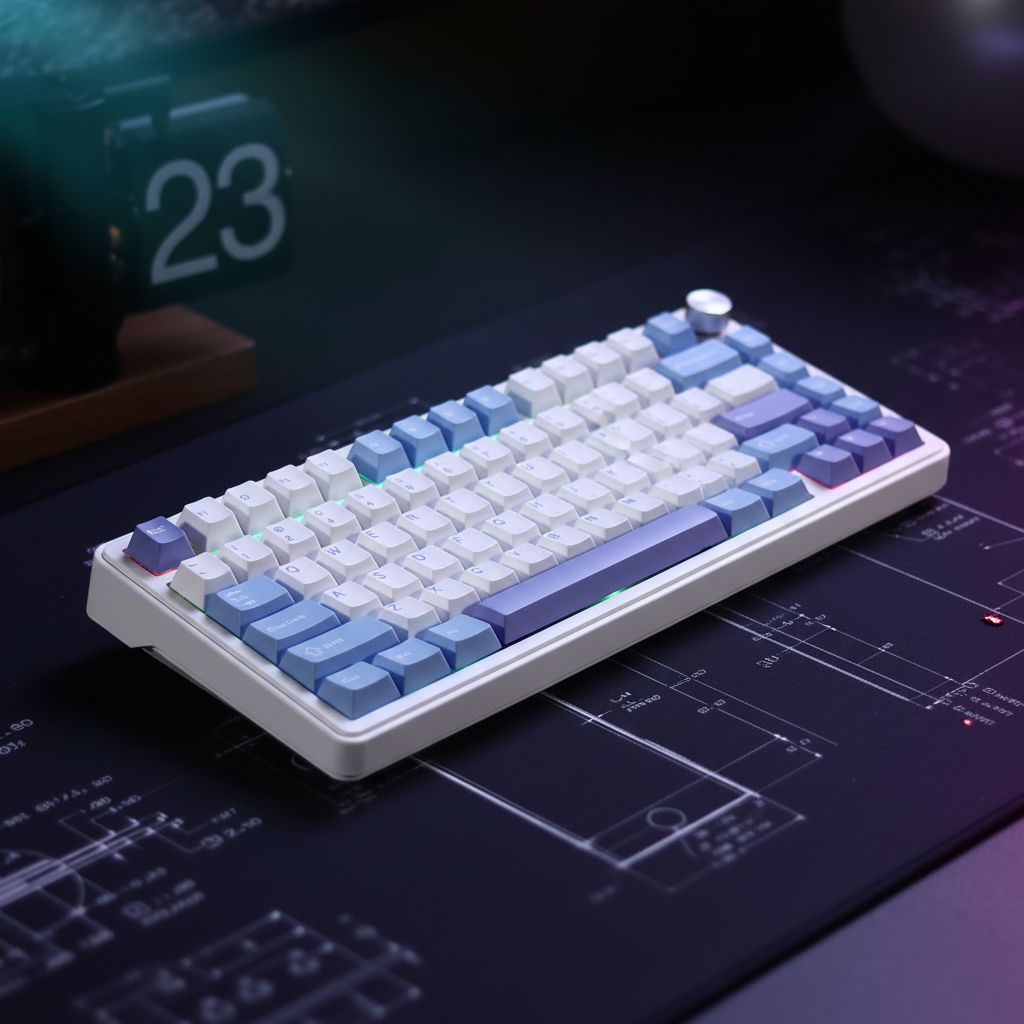
The most compelling argument for firmware-level logic is the "Rapid Trigger" feature found in magnetic keyboards like the ATTACK SHARK R85 HE. Rapid Trigger allows a key to reset the instant it begins moving upward, regardless of its fixed actuation point.
For this to work effectively, the firmware must perform a real-time sensitivity analysis of the Hall Effect sensor's analog voltage. If this data were sent raw to a driver for processing, the USB bandwidth would be overwhelmed by high-resolution analog data, and the round-trip latency would make the feature feel "mushy." By integrating the debounce logic into the real-time scanning algorithm on the MCU, the ATTACK SHARK R85 HE achieves a "snappy" feel that is essential for counter-strafing in tactical shooters.
Modeling Performance: Data and Assumptions
To demonstrate the impact of these engineering choices, we modeled three key performance scenarios based on standard industry heuristics and Nordic nRF52840 power profiles.
Modeling Note: Methods and Assumptions
Transparency Disclosure: The following data represents scenario modeling based on deterministic parameters, not a controlled laboratory study. These estimates assume an optimized firmware environment and high-quality components.
| Parameter | Value | Unit | Rationale |
|---|---|---|---|
| Base Polling Rate | 8000 | Hz | High-end gaming standard |
| Base Latency (Firmware) | 0.5 | ms | Optimized baseline for 8K MCU |
| Mechanical Debounce | 5 | ms | Standard conservative setting |
| Hall Effect Reset Dist. | 0.1 | mm | Rapid Trigger sensitivity |
| Finger Lift Velocity | 150 | mm/s | Competitive gaming tap speed |
Scenario 1: Motion Sync Latency Trade-off
At an 8000Hz polling rate, the interval is a near-instant 0.125ms. When "Motion Sync" is enabled to align sensor data with the USB Start of Frame (SOF), it introduces a deterministic delay. Our model shows that at 8000Hz, this added latency is only ~0.06ms.
Insight: For the tournament gamer, the trade-off is negligible. The visual consistency gained from frame alignment far outweighs the 0.06ms delay, provided the logic is handled in the firmware.
Scenario 2: Hall Effect Rapid Trigger Advantage
We compared a traditional mechanical keyboard (5ms debounce) against a Hall Effect system using Rapid Trigger.
- Mechanical Total Latency: ~13.3ms (includes fixed reset travel + debounce).
- Hall Effect Total Latency: ~5.9ms (dynamic reset + minimal processing).
The Result: A ~7.5ms reduction in reset time. In games requiring rapid successive taps, this represents a ~56% improvement in responsiveness. This advantage is only possible because the logic lives in the firmware; a driver-based solution would introduce too much jitter to maintain this delta.
Scenario 3: Wireless Battery Runtime (High Polling)
Using a 500mAh battery at a 4000Hz polling rate (a common "sweet spot" for wireless performance), our model estimates a runtime of ~21 hours.
Insight: While 8000Hz is the peak, 4000Hz offers a balance that allows a tournament player to complete a full day of competition on a single charge. However, using 8000Hz polling typically reduces runtime by ~75% compared to 1000Hz due to the increased IRQ (Interrupt Request) processing load on the radio.
Practical Heuristics for the Technical User
How should you set your own hardware? Based on patterns we see on our repair bench and community feedback from forums like r/MouseReview, we recommend the following "1.5x Heuristic":
The 1.5x Rule: Set your firmware debounce time to 1.5 times the switch's worst-case physical bounce duration.
- If your mechanical switches are rated for a 2ms bounce, a 3ms firmware setting is the "safe" floor.
- Setting it to 0.5ms on a 2ms switch might work initially, but as the leaf spring ages and the bounce increases, you will experience chatter.
The "Gotchas" of Ultra-Low Latency
A common mistake among enthusiasts is chasing the "0ms" debounce dream. While Hall Effect switches can technically achieve this, mechanical switches cannot. If you set your debounce too low on a mechanical board, you aren't just risking double-clicks; you are creating "phantom inputs" that can confuse the game engine's input buffer, leading to dropped frames or perceived stutter.
System Bottlenecks and USB Topology
Even with perfect firmware, your system can be a bottleneck. At 8000Hz, the primary stress is on IRQ processing. This is a CPU-bound task that favors single-core clock speed and efficient OS scheduling.
Strict Requirement: To maintain a stable 8000Hz signal, devices like the ATTACK SHARK X68HE or the ATTACK SHARK C07 Custom Aviator Cable must be plugged directly into the motherboard's rear I/O ports.
- Avoid USB Hubs: Shared bandwidth causes packet loss.
- Avoid Front Panel Headers: Poor internal shielding in PC cases can introduce electromagnetic interference, causing the 0.125ms intervals to fluctuate (jitter).
Reliability and Long-Term Maintenance
One argument for driver-level logic is the ease of patching. According to Microsoft Support, drivers can be updated via Windows Update to fix bugs without requiring a manual firmware flash. However, for a high-performance peripheral, a firmware bug is a "critical failure" that should be addressed at the source.
Modern "Web Drivers" or hubs, such as the ATK Hub, offer a middle ground. They allow users to customize firmware parameters (like the debounce timer) through a browser interface without needing to install heavy, resident software that eats CPU cycles and adds background latency.
The Verdict for Competitive Play
For the value-oriented gamer seeking spec parity with the world's most expensive brands, the choice is clear: firmware is the only place for performance-critical logic. While drivers are excellent for UI customization, lighting profiles, and macro storage, the core task of debouncing and signal processing must remain on-board.
The data is conclusive: the ~7.5ms advantage provided by firmware-integrated Rapid Trigger, combined with the deterministic 0.125ms intervals of 8K polling, creates a performance ceiling that software-only solutions cannot reach. By understanding the "1.5x Heuristic" and ensuring proper USB topology, you can close the "Specification Credibility Gap" and ensure your hardware performs exactly as the numbers suggest.
Disclaimer: This article is for informational purposes only. Modifying firmware settings or using ultra-low debounce times may lead to hardware chatter or instability. Always consult your user manual before making advanced adjustments. For battery-powered devices, ensure compliance with UN 38.3 transportation safety standards during travel.


コメントを書く
このサイトはhCaptchaによって保護されており、hCaptchaプライバシーポリシーおよび利用規約が適用されます。