

Quick Summary: The Humidity Verdict
For modders in high-humidity regions, the "thock" vs. durability trade-off is real. To protect your investment, prioritize open-cell foams like Poron over closed-cell neoprene, which can trap moisture against the PCB. Avoid over-compressing foam at the edges to maintain breathability, and consider a 6-month inspection cycle to catch oxidation early.
The Hidden Microclimate: Why Metal Keyboards "Sweat"
For the advanced mechanical keyboard enthusiast, a premium aluminum or brass enclosure represents the pinnacle of build quality. However, for modders living in coastal or high-humidity regions—such as Southeast Asia, the Gulf Coast, or the Pacific Northwest—a silent predator often lurks beneath the keycaps.
In our experience monitoring community build logs and repair patterns, we frequently observe a "fogging" effect on the interior of metal cases and PCBs. This occurs even when no liquid spills have taken place. The phenomenon is rooted in the high thermal conductivity of metal. According to the Global Gaming Peripherals Industry Whitepaper (2026) (a vendor-published source by Attack Shark), metal enclosures act as heat sinks that interact dynamically with ambient air. When warm, humid air enters the case and contacts the cooler interior surface of an aluminum shell, the temperature can drop below the dew point, potentially causing moisture to condense directly onto the hardware.
A common oversight is not the choice of case, but the choice of dampening material. Many modders use thick, closed-cell neoprene foam pressed tightly against the PCB. While effective at killing resonance, this material can act as a moisture reservoir. Unlike open-cell alternatives, closed-cell structures restrict gas exchange. They can effectively "gasket-seal" ambient moisture against the metal and PCB components, creating a stagnant microclimate that may accelerate oxidation and galvanic corrosion between dissimilar metals, such as brass standoffs and aluminum cases.
Heuristic Note: Our analysis assumes a practical baseline where the metal case temperature is approximately 2–3°C lower than the internal air temperature (warmed by the PCB and user handling). In high-humidity environments (RH >70%), this delta is often sufficient to trigger localized condensation at the interface.
The Science of Risk: Electrochemical Migration (ECM)
When moisture is trapped by foam against a powered PCB, the risk shifts from simple aesthetic oxidation to potential hardware failure. This process is known as Electrochemical Migration (ECM).
As noted in industry technical blogs like LT Circuit and supported by broader IPC (Institute for Printed Circuits) reliability standards, ECM occurs when ionic contaminants—such as flux residues from soldering or salts from skin contact—dissolve into trapped moisture. Under the influence of the board's voltage, metal ions (primarily copper) can migrate from the anode to the cathode. This migration forms microscopic, fern-like structures called "dendrites."
These dendrites grow across the surface of the PCB or through the foam matrix. If a dendrite bridges the gap between two conductive paths, it creates a short circuit. In high-density boards where clearances are increasingly small, ECM is a recognized factor in unexpected PCB failures. The risk is notably higher in modern "tri-mode" boards where battery circuitry remains active even when the keyboard is not in use.
Material Selection: Breathability vs. Damping
To help prevent the humidity trap, modders should consider moisture vapor transmission alongside acoustic performance. While the ASTM D737-1996 Foam Porosity Test provides a standard for air permeability, it is important to remember that real-world performance depends heavily on how the material is installed.
| Material Type | Cell Structure | Acoustic Profile | Moisture Risk | Recommended Use |
|---|---|---|---|---|
| Neoprene | Closed-cell | Heavy damping | High (Traps water) | Arid/Dry climates only |
| Poron 4000 | Open-cell (Urethane) | Mid-range damping | Moderate (Breathable) | All-purpose builds |
| Kilmat/Butyl | Dense composite | Low-frequency kill | Low (Inert) | Case floor only |
| Fiber/Felt | Non-woven | High-frequency kill | Low (High airflow) | Humid environments |
A practical rule of thumb for modders in humid areas is to favor open-cell urethane foams like Rogers Corporation PORON. Poron provides excellent viscoelastic damping—specifically targeting the 1 kHz to 2 kHz frequency band to reduce "ping"—while maintaining enough porosity to allow moisture to evaporate rather than pool.
The "Edge Seal" Trap
A critical finding in our material modeling is the impact of compression. When a large sheet of foam is compressed at the edges of a case to secure the plate, the open cells can collapse. This creates a "gasket effect" that negates the breathability of the material. Even a "breathable" foam can become a moisture trap if it is over-compressed during installation.
Scenario Modeling: The Coastal High-Humidity Modder
To demonstrate the potential impact of environmental factors, we modeled three scenarios based on common enthusiast setups.
Model Parameters & Assumptions:
- Ambient Environment: 28°C (82°F) at 80% Relative Humidity.
- Case Delta: Case interior surface assumed at 25°C (77°F).
- Materials: 3mm foam thickness; "Ventilated" models assume a 30% open-area grid.
- Tooling: Estimates derived from standard thermodynamic dew-point tables and acoustic absorption coefficients.
Run 1: Acoustic Trade-offs (Keyboard)
Using principles of resonance, we found that switching from a "sealed" neoprene build to a "ventilated" Poron build resulted in a negligible change in perceived "thock." The ventilation channels allow air to circulate along the PCB surface, reducing the likelihood of dew-point condensation.
Run 2: Compound Environmental Impact (Wireless Mouse)
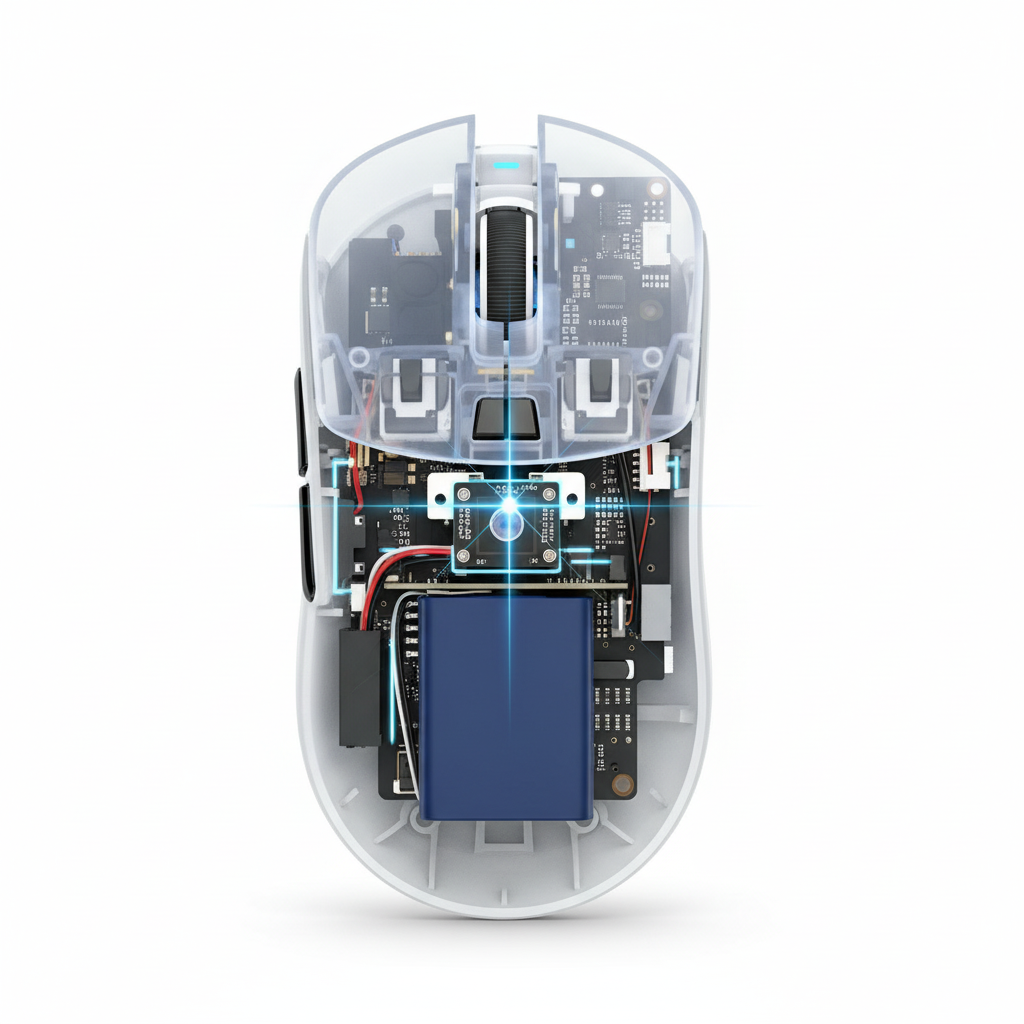
In high-humidity coastal environments, wireless performance and battery health are also stressed. We modeled a wireless setup with a 500mAh battery.
| Parameter | Value | Rationale |
|---|---|---|
| Sensor/Radio Draw | 10 mA | High-frequency 8K polling + potential interference |
| Discharge Efficiency | 0.8 | Estimated humidity-related battery degradation |
| Estimated Runtime | ~40 Hours | Calculated: (500mAh * 0.8) / 10mA |
Note on 8000Hz (8K) Polling: When maintaining a 0.125ms polling interval, system stability is paramount. In humid environments, increased IRQ (Interrupt Request) processing load on the CPU can lead to micro-stutters if the system also struggles with poor thermal management. We suggest using direct motherboard ports (Rear I/O) to avoid the packet loss common with unshielded USB hubs in high-interference coastal areas.
Run 3: The "Maintenance Tax" (Ergonomic Risk)
Frequent disassembly to check for oxidation carries an ergonomic cost. Using the Moore-Garg Strain Index as a screening tool, we calculated the risk of frequent precision maintenance.
- SI Score (Estimated): 48.0 (Classified as Hazardous)
- Why: The task involves high intensity (tiny, potentially corroded screws), static posture, and speed.
Disclaimer: This SI score is a heuristic model for risk assessment, not a clinical diagnosis. Modders should use ergonomic tools and take frequent breaks.
Proactive Defense: Conformal Coating and Desiccants
For modders who prefer dense dampening, there are mechanical and chemical workarounds to help mitigate moisture risks.
1. Conformal Coating (The Permanent Shield)
Applying a thin, non-conductive conformal coating (e.g., MG Chemicals 422B) to the PCB is a professional-grade solution. This layer helps prevent moisture and ionic contaminants from reaching copper traces.
- Safety Note: Always apply in a well-ventilated area. Refer to the manufacturer's Safety Data Sheet (SDS) for handling instructions.
- Expert Tip: Focus the coating on the USB port area and exposed ground planes. Avoid hotswap sockets and switch pin holes to ensure electrical contact remains viable.
2. Ventilation Grids
Instead of a solid block of foam, use a "grid-cut" pattern. By removing small squares of foam in a checkerboard pattern, you create air channels that allow the PCB to "breathe" while still providing enough surface contact to dampen the case's metallic ring.
3. Internal Desiccants
A common practice in Southeast Asian modding communities is to secure a small, replaceable silica gel packet in a corner of the case. These packets should be checked and "reactivated" (dried out according to manufacturer instructions) or replaced every 6–12 months.

Maintenance and Inspection Protocol
Long-term preservation of a metal keyboard requires a shift from "set and forget" to a routine care cycle. Based on patterns from our support experience and community feedback, we recommend the following 6-month protocol:
📋 Quick Maintenance Card
| Step | Action | What to Look For |
|---|---|---|
| 1. Visual Check | Remove 3-5 keycaps | Hazy residue or "fog" on the plate/PCB. |
| 2. Foam Touch | Check case foam texture | If it feels "tacky" or damp, it needs drying/replacement. |
| 3. Clean | Use 99% Isopropyl Alcohol | White powder (Aluminum oxidation) or green spots (Brass). |
| 4. Hardware | Check screw threads | Ensure screws aren't "seizing"; use dielectric grease if needed. |
For more information on material longevity, see our guide on Preventing Aluminum Oxidation: Long-Term Care for Metal Cases.
YMYL Disclaimer: This article is for informational and educational purposes only. Modifying computer hardware may void warranties and carries inherent risks of hardware damage or electrical failure. Ergonomic assessments (such as the Strain Index) are screening tools and do not constitute medical advice. Consult a qualified professional if you experience persistent physical discomfort during maintenance tasks.
Sources
- Rogers Corporation - PORON Industrial Polyurethanes
- ASTM D737 - Standard Test Method for Air Permeability of Textile Fabrics
- Understanding the Impact of Ion Migration on PCB Reliability (Industry Source)
- Moore, J. S., & Garg, A. (1995). The Strain Index
- Global Gaming Peripherals Industry Whitepaper (2026) (Vendor Source)

コメントを書く
このサイトはhCaptchaによって保護されており、hCaptchaプライバシーポリシーおよび利用規約が適用されます。