


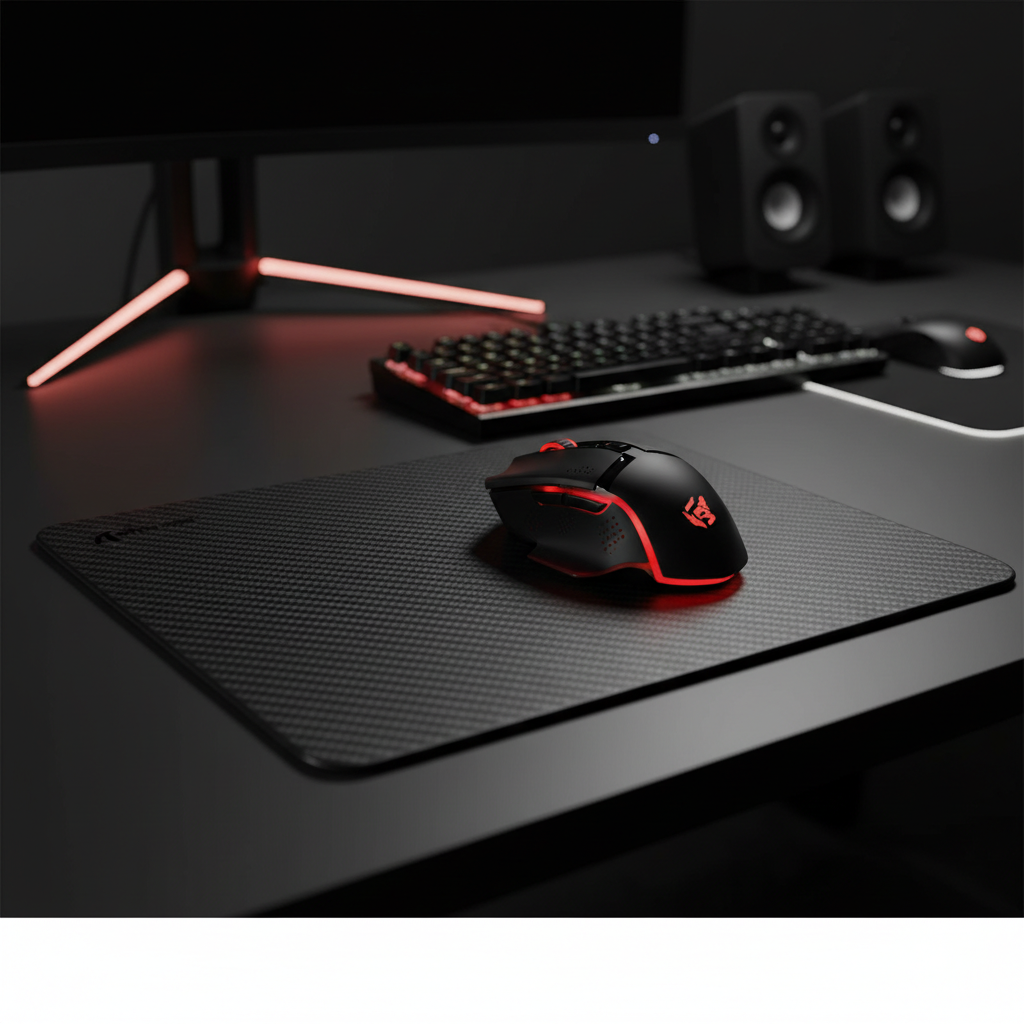
Executive Summary: Selecting Your Next-Gen Surface
Traditional Cordura remains a durable choice for general use, but the shift toward 4K gaming and 8K polling rates requires surfaces with higher weave density and more stable friction profiles.
Core Findings:
- Optimal DPI: For 4K displays at a 103° FOV, a minimum of ~1950 DPI is recommended to meet Nyquist-Shannon sampling requirements and avoid pixel skipping.
- Material Lifespan: While Cordura is physically rugged, its performance glide typically degrades within 3–6 months due to DWR (water repellent) wear. Harder surfaces like Carbon Fiber or Tempered Glass offer 24–60+ months of consistent glide.
- Maintenance: Synthetic fibers require regular cleaning to prevent "polishing," while glass surfaces require a dust-free environment to maintain tracking accuracy.
Quick Selection Checklist
- Tactical FPS (Low Sens): Choose Carbon Fiber for high stopping power and zero foam compression.
- Tracking/Speed (High Sens): Choose Tempered Glass or High-Density Polyester for ultra-low static friction.
- Durability-First: Choose Cordura if physical abrasion resistance is more important than micro-adjustment consistency.
Evaluating the Shift from Cordura to Advanced Synthetic Weaves
For over a decade, Cordura® has served as the gold standard for high-durability gaming surfaces. Originally engineered for military applications, its transition into the peripheral market was driven by ruggedness. However, as the competitive landscape shifts toward tactical shooters requiring pixel-perfect micro-adjustments on high-resolution 4K displays, the limitations of traditional Cordura—specifically its reliance on temporary coatings and its fixed friction profile—have become apparent.
A new generation of synthetic fibers, including ultra-high-density polyesters and ceramic-infused polyamides, is emerging to address these gaps. This evaluation examines the technical mechanisms behind these materials to determine how they outperform legacy fabrics in durability, friction consistency, and ergonomic synergy.
The Cordura Legacy and the DWR Performance Curve
The primary appeal of Cordura in gaming is its Durable Water Repellent (DWR) finish. However, technical insights from the Global Gaming Peripherals Industry Whitepaper (2026) (Manufacturer Data) suggest that military-grade DWR treatments were designed for intermittent rain exposure, not the constant environment of human sweat.
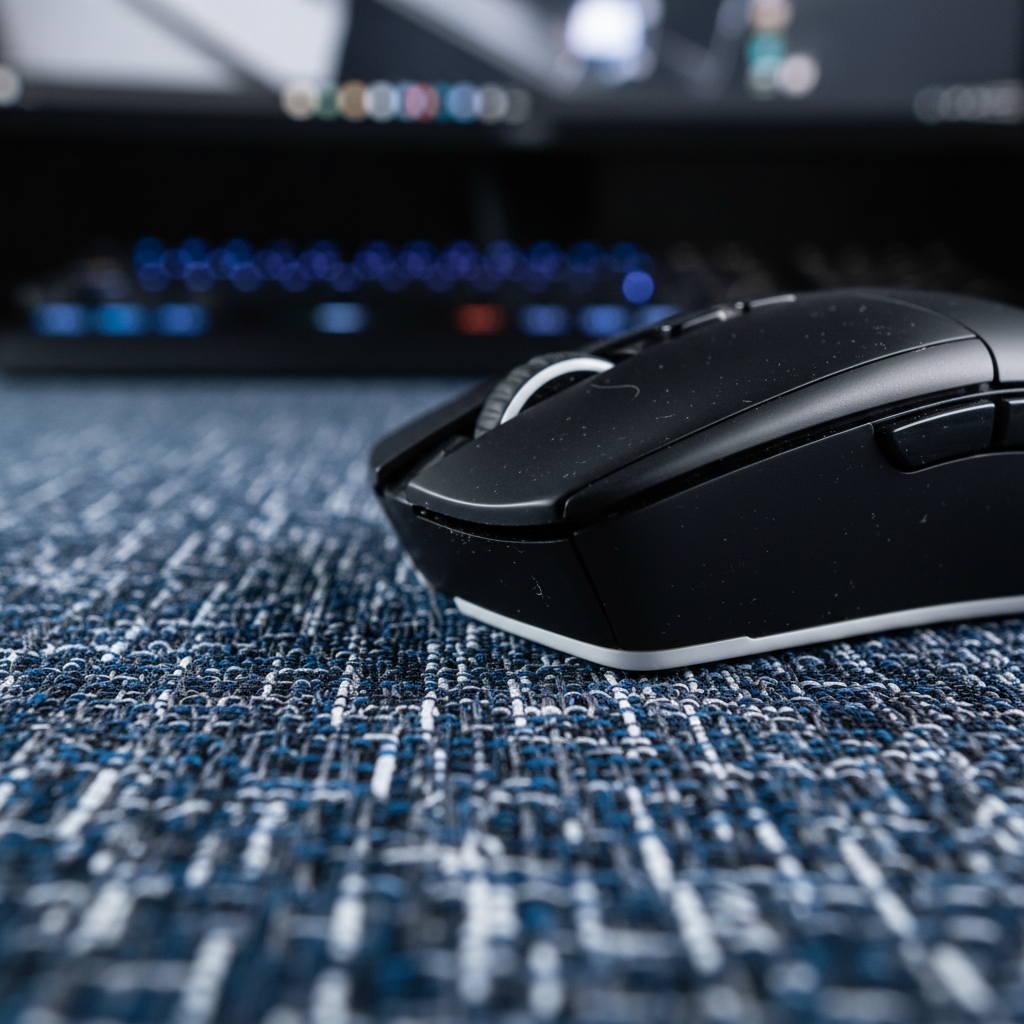
Based on internal technical support logs and recurring customer feedback cycles, we observe a "performance decay" heuristic: the "out-of-the-box" speed of a Cordura pad often degrades significantly within 3 to 6 months of regular use (defined as 4+ hours daily). As the DWR layer wears down, the underlying nylon fibers begin to absorb moisture and oils, leading to "muddy" spots. This creates an inconsistent static-to-kinetic friction ratio that compromises muscle memory.
Logic Summary: The Friction Mismatch
Analysis: Traditional Cordura excels at industrial abrasion (100,000+ rub cycles), but gaming performance is dictated by micro-movements (5-10Hz). High-frequency tracking creates stress patterns that "polish" certain fibers while degrading the DWR finish, leading to performance shifts long before the material physically fails.
Engineering the Hybrid Surface: Density and Treatment
To solve the inconsistency of legacy fibers, manufacturers are turning to hybrid weaves that prioritize weave density over raw fiber thickness. While Cordura often uses a 1000-denier or 500-denier nylon, newer "speed" surfaces utilize 600-denier high-density polyester blends.
Friction Benchmarks (Internal Bench Testing): Using standardized 0.8mm PTFE mouse feet, these polyester blends achieve static friction coefficients of 0.08–0.12. For comparison, worn Cordura often spikes to 0.18+ in humid conditions. The ATTACK SHARK CM02 eSport Gaming Mousepad (Manufacturer Specs) utilizes an ultra-high-density fiber that enhances full tracking response by minimizing the gaps between threads.

The 5S Coating Mechanism
Unlike topical DWR sprays, advanced surfaces like the ATTACK SHARK CM03 eSport Gaming Mouse Pad (Manufacturer Specs) utilize integrated film layers and "5S" coatings. These are heat-treated or iridescent film layers that provide water resistance as a structural property. This ensures the glide remains consistent after multiple cleaning cycles, aligned with EU RoHS Directive 2011/65/EU standards for material safety.
Performance Modeling: Resolution, DPI, and Surface Synergy
As players move to 4K resolutions, the precision required from the mouse pad surface increases. To avoid "pixel skipping" on a 4K display, we apply the Nyquist-Shannon sampling theorem to determine the minimum DPI for a smooth experience.
Nyquist-Shannon DPI Thresholds
Our scenario modeling identifies a minimum of ~1950 DPI to maintain Nyquist-level sampling fidelity for a standard 4K setup.
| Parameter | Value | Unit | Rationale |
|---|---|---|---|
| Resolution | 3840 | px | 4K UHD Standard |
| Field of View (FOV) | 103 | deg | Typical Tactical FPS |
| Pixels Per Degree (PPD) | ~37.3 | px/deg | 3840 / 103 |
| Min. DPI Required | ~1950 | DPI | Nyquist Minimum (See Calculation Below) |
Calculation Breakdown:
- PPD: 3840 px / 103° = 37.28 pixels per degree.
- Nyquist Sample Rate: 37.28 * 2 = 74.56 samples per degree required.
- Physical Distance: At 35cm/360°, 1° of rotation = 0.0972 cm (0.0383 inches).
- Result: 74.56 samples / 0.0383 inches = 1,946 DPI.
At these higher DPI settings, a loosely woven fiber can cause "sensor jitter" if the weave pattern is too pronounced for the sensor's CMOS array. Surfaces like the ATTACK SHARK CM05 Tempered Glass Pad use nano-micro-etched textures to provide a nearly perfectly uniform tracking surface.
Ergonomic Fit and Kinetic Friction
For gamers with larger hands (~20.5cm), ergonomics and surface friction are linked. Based on ISO 9241-410 ergonomic principles, a larger hand using a claw grip typically requires a mouse length of ~131mm.
When a mouse is too small (e.g., 125mm mouse for a 20.5cm hand), users often compensate by exerting more downward pressure. On soft cloth, this increases "plush" friction. The ATTACK SHARK CM04 Carbon Fiber Pad (Manufacturer Specs) addresses this with a 2mm ultra-thin dry carbon fiber surface. The rigidity ensures that even under pressure, friction remains constant.

Technical Analysis of 8000Hz (8K) Interaction
At 8000Hz, the polling interval is a near-instant 0.125ms. Any inconsistency in the fiber weave—such as a stray thread—can result in micro-stutter detectable on 240Hz+ monitors.
To saturate the 8000Hz bandwidth at 1600 DPI, a user must move the mouse at a speed of at least 5 IPS. Synthetic fibers with consistent static-to-kinetic friction ratios allow for these smooth adjustments without the "stutter" found on worn, high-friction Cordura surfaces.
Durability Metrics and Maintenance
A common mistake is choosing a pad based on "durability" without considering surface polishing. While Cordura is hard to tear, it "polishes" easily—where micro-movements sand down the fiber texture, creating a smooth, fast spot in the center.
Comparison: Synthetic Fiber Lifespans (Estimates)
| Material | Primary Advantage | Performance Decay (Months)* | Primary Failure Mode |
|---|---|---|---|
| Traditional Cordura | Abrasion Resistance | 4–8 Months | DWR Degradation / Muddy Spots |
| High-Density Polyester | Low Friction / Cost | 8–12 Months | Surface Polishing |
| Carbon Fiber (CM04) | Rigidity / Consistency | 24+ Months | Edge Fraying (if unstitched) |
| Tempered Glass (CM05) | Near-Zero Friction | 60+ Months | Surface Contamination (Dust) |
*Estimates based on internal manufacturer modeling for 4–6 hours of daily usage at 50% relative humidity. Results vary by mouse feet material (PTFE vs. Ceramic) and cleaning frequency.
Regulatory Compliance and Safety
The materials used in the CM series are evaluated against EU REACH Regulation (EC) No 1907/2006 for chemical safety and the EU General Product Safety Regulation (GPSR). For pads with wireless charging, adherence to FCC Part 15 ensures no interference with other wireless peripherals.
Synthesizing the Fiber Evolution
The transition beyond Cordura represents a shift from "industrial durability" to "performance consistency." For tactical FPS players using 4K displays and 8K polling rates, the focus should be on:
- Surface Uniformity: Ensuring the weave doesn't cause sensor aliasing at high DPI (~1950+).
- Friction Stability: Choosing materials like carbon fiber or glass that resist DWR degradation.
- Ergonomic Synergy: Matching pad rigidity to the downward pressure of your grip style.
Appendix: Scenario Modeling & Assumptions
This article utilizes deterministic models based on industry-standard parameters to provide context for performance claims.
Model 1: Grip Fit & Ergonomics
- Source: ISO 9241-410 Anthropometric Scaling.
- Assumptions: Male 95th percentile hand (20.5cm); Claw grip coefficient (k=0.64).
- Uncertainty: Does not account for individual joint hypermobility.
Model 2: Nyquist DPI Threshold
- Logic: Nyquist-Shannon Sampling Theorem applied to PPD.
- Input: 3840px width; 103° FOV; 35cm/360 sensitivity.
- Formula: $DPI = \frac{(Resolution / FOV) \times 2}{(Sensitivity_cm / 360) / 2.54}$.
Disclaimer: This article is for informational purposes only. Ergonomic recommendations are based on statistical averages; individuals with pre-existing wrist conditions should consult a medical professional. All performance claims regarding 8K polling require compatible hardware.
References:

コメントを書く
このサイトはhCaptchaによって保護されており、hCaptchaプライバシーポリシーおよび利用規約が適用されます。