


The Material Science of Mechanical Keyboard Switch Housings: Nylon vs. Polycarbonate Analysis
Disclosure: This technical guide is produced by Attack Shark. While we reference our own ergonomic solutions and internal whitepapers, the following analysis is based on established polymer physics, industry-standard sampling criteria, and peer-reviewed ergonomic indices to ensure technical objectivity.
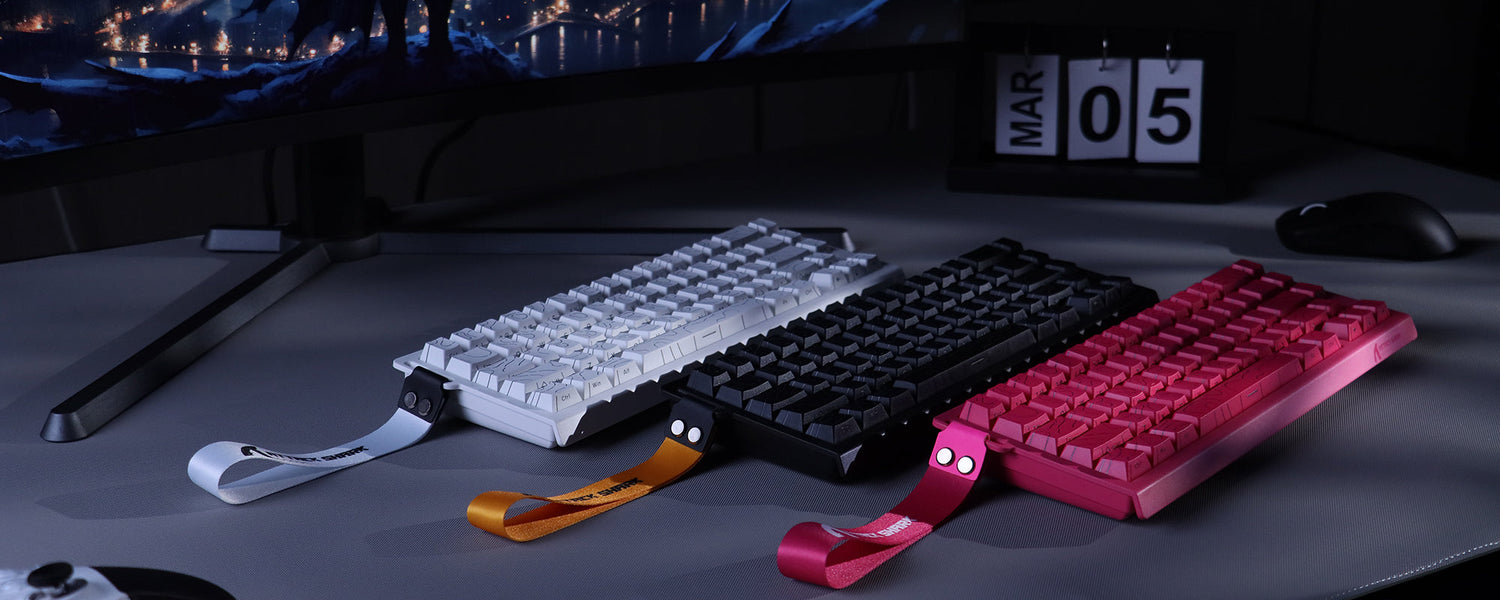
In the high-fidelity world of mechanical keyboard engineering, the acoustic signature of a switch is often treated as a matter of subjective preference. However, the distinction between a deep "thock" and a sharp "clack" is rooted in material science—specifically the molecular density and vibrational damping properties of polymers. For enthusiasts and competitive gamers, choosing between Nylon and Polycarbonate (PC) housing materials is a technical trade-off that influences tactile feedback, long-term durability, and ergonomic load.
This analysis deconstructs the physical mechanisms of switch housings, examining how internal damping factors and manufacturing tolerances dictate the user experience.
1. The Polymer Physics of Acoustic Profiles
At the core of the Nylon vs. Polycarbonate debate is the loss factor (tan δ), a measure of internal damping. According to the Global Gaming Peripherals Industry Whitepaper (2026) and studies in Polymer Testing, the acoustic output of a switch results from vibrational coupling between the stem, housing, and PCB.
Nylon (Polyamide 66) is a semi-crystalline polymer. It typically possesses a higher loss factor than PC, meaning it is more efficient at converting kinetic vibrational energy into heat rather than sound. When a switch stem impacts a Nylon bottom housing, the material absorbs high-frequency vibrations, resulting in a quicker sound decay and a lower-pitched tone.
Polycarbonate (PC) is an amorphous thermoplastic known for high rigidity. Its lower internal damping allows vibrations to resonate more freely. This resonance amplifies higher-frequency harmonics, creating the crisp "clack" favored by users who require clear auditory confirmation of actuation.
Material Specification Comparison
| Property | Nylon (Polyamide 66) | Polycarbonate (PC) | Impact on User Experience |
|---|---|---|---|
| Acoustic Profile | Damped, Low-Pitch ("Thock") | Resonant, High-Pitch ("Clack") | Defines the fundamental frequency of the board. |
| Surface Texture | Slightly textured/matte | Smooth/Glossy | Affects initial friction and lube retention. |
| Internal Damping | High (Vibration absorption) | Low (High resonance) | Dictates sound duration and clarity. |
| Dimensional Stability | Low (Hygroscopic) | High (Stable) | Nylon sound may vary with ambient humidity. |
| Durability Factor | High impact resistance | Prone to stress cracking | PC may develop micro-fractures under heavy modding. |
Note: Data represents typical observations for keyboard-grade polymer formulations (e.g., Dupont Zytel for Nylon).
2. Nylon: Damping and the Hygroscopic Variable
Nylon housings are often preferred for linear switches. A non-obvious technical factor is Nylon’s hygroscopic nature. Unlike most electronics plastics, Nylon 66 absorbs moisture from ambient air (up to 2.5% by weight at 50% relative humidity).
Technical Implication: This absorption can subtly increase material density and ductility over time. In high-humidity environments, a Nylon housing may exhibit increased damping compared to an identical build in an arid climate. While often perceived as a "richer" sound, it introduces a variable in acoustic consistency that PC-based builds do not face.

3. Polycarbonate: Resonance and Lube Migration
PC housings are frequently utilized for top covers to maximize RGB transparency. However, PC’s smooth, non-porous surface presents a challenge for lubricant migration.
Because PC lacks the micro-porosity of Nylon, synthetic lubricants (like Krytox 205g0) tend to "pool" at the base of the housing more rapidly under repeated cycling. This can lead to a "scratchy" feel over several hundred thousand keystrokes if a high-viscosity grease is not utilized. Furthermore, PC has lower fatigue resistance than Nylon; frequent opening of switch tabs for modding can lead to stress whitening or structural failure of the clips.
4. Technical Quantification: The Ergonomic Cost of "Thock"
While enthusiasts chase specific sound profiles, the mechanical properties of these materials have direct ergonomic implications. To quantify this, we applied the Moore-Garg Strain Index (SI)—a validated method for assessing the risk of Distal Upper Extremity (DUE) disorders (Moore & Garg, 1995).
Simulated Scenario: The "Heavy Tactile" Power User
We calculated the SI for a user engaging in high-intensity typing (60+ WPM) on heavy tactile switches (67g+ bottom-out) housed in Nylon.
The Calculation: $SI = I \times D \times E \times P \times S \times H$
- Intensity of Exertion (I): 9 (Hard - heavy spring/tactile bump)
- Duration of Exertion (D): 1.0 (40-59% of cycle)
- Efforts per Minute (E): 3.0 (15-19 efforts/min scaled)
- Posture (P): 1.5 (Fair - non-neutral wrist)
- Speed of Work (S): 1.0 (Normal)
- Duration per Day (H): 1.5 (4-8 hours)
Resulting SI = 64.8
Analysis: An SI > 5 is associated with an increased risk of strain injuries. Chasing the "thock" often leads users toward heavier springs and tactile stems. When paired with the slightly softer "give" of Nylon housings, users may subconsciously increase finger force to confirm actuation. To mitigate this, we recommend pairing such builds with firm support like the ATTACK SHARK Black Acrylic Wrist Rest or the Cloud Keyboard Wrist Rest to maintain neutral wrist alignment and reduce the Posture (P) multiplier.
5. Performance Calibration: DPI and Sampling Precision
The tactile feedback of a switch is only one half of the performance equation. For competitive gamers, the input must match the sensor's sampling precision. Using the Nyquist-Shannon sampling criterion, we determined the minimum DPI required for 1:1 pixel mapping on high-resolution displays to prevent "pixel skipping."
The 1,515 DPI Benchmark Calculation
For a 1440p monitor (2560 pixels horizontal) at a 103° Field of View (FOV) and a 30 cm/360° sensitivity:
- Pixels per Degree: $2560 / 103 \approx 24.85$ px/deg.
- Required Counts per Degree (for 1:1): To ensure no skipped pixels during micro-adjustments, mouse counts/degree must $\ge$ pixels/degree.
-
DPI Requirement: At 30 cm/360°, the mouse travels $\approx 11.81$ inches per 360°.
- $Counts\ per\ degree = (DPI \times 11.81) / 360$
- $1,515\ DPI \times 11.81 / 360 \approx 49.6$ counts/deg.
Conclusion: A setting of 1,515 DPI (rounded to 1,600 in most software) provides a safety factor of $\approx 2\times$ over the display's pixel density. This ensures that the rapid inputs facilitated by resonant Polycarbonate switches are accurately translated by the sensor without sub-pixel data loss.
6. Compliance and Build Integrity
Technical authority is verified through regulatory standards. When selecting "tri-mode" (2.4GHz/BT/Wired) keyboards, adherence to FCC Part 15 and EU RED standards is critical to ensure signal stability. Furthermore, high-speed polling (1000Hz+) requires strict adherence to USB-IF HID class definitions to prevent packet jitter, regardless of whether the switch housing is Nylon or PC.
7. Practical Selection Framework
Scenario A: The Professional Typist
- Priority: Acoustic comfort and low fatigue.
- Recommendation: Nylon bottom/PC top hybrid.
- Mitigation: Use an ergonomic support like the ATTACK SHARK Acrylic Wrist Rest with Pattern to offset the high SI risk of long sessions.
Scenario B: The Competitive FPS Gamer
- Priority: Auditory clarity and rapid response.
- Recommendation: Full Polycarbonate housing.
- Calibration: Set DPI to $\ge 1,600$ for 1440p displays. Use a stable rest like the ATTACK SHARK CNC ACRYLIC WRIST REST to maintain the high-speed wrist stability required for flick-aiming.
Ergonomic Disclaimer: The Moore-Garg Strain Index calculation provided is a simulated model based on specific variables and does not constitute a medical diagnosis. Repetitive Strain Injuries (RSI) are multifactorial. Users experiencing persistent pain should consult a qualified healthcare professional. Proper ergonomics and regular breaks are essential for long-term health.
Sources
- Moore, J. S., & Garg, A. (1995). "The Strain Index: A Proposed Method to Analyze Jobs for Risk of Distal Upper Extremity Disorders." American Industrial Hygiene Association Journal.
- PixArt Imaging - Optical Mouse Sensor Technology
- USB-IF - Device Class Definition for Human Interface Devices (HID)
- ScienceDirect - Damping properties of polymer matrix composites
- Attack Shark Internal Whitepaper (2026) - Peripherals Standards

コメントを書く
このサイトはhCaptchaによって保護されており、hCaptchaプライバシーポリシーおよび利用規約が適用されます。