


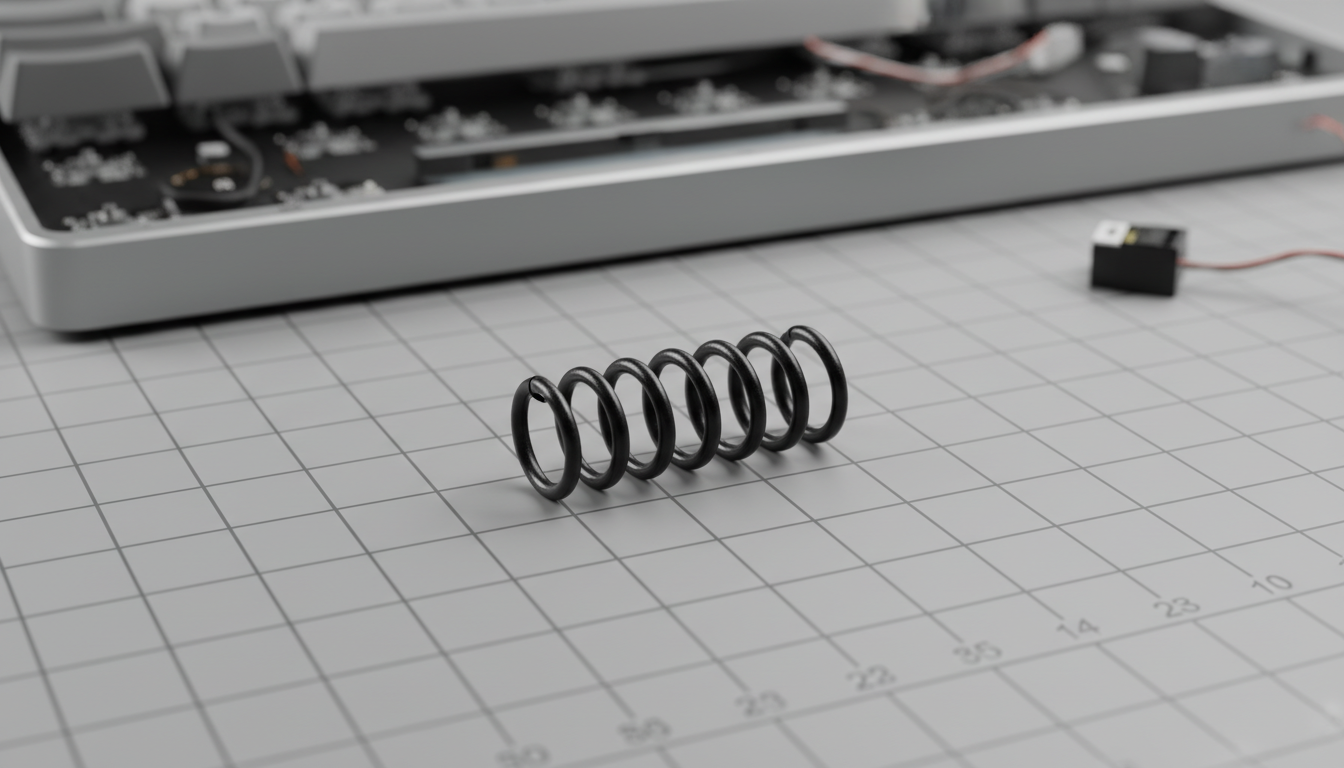
Executive Summary: The "Sweet Spot" for Switch Longevity
For users seeking to maximize keyboard lifespan, the choice of spring weight is a balance between mechanical reset reliability and housing wear.
- Optimal Range: For most users, a 50g–65g bottom-out force provides the best compromise, offering sufficient return force to prevent "key chatter" without inducing excessive rail wear.
- Risk Thresholds: Springs below 35g may lead to inconsistent resets (chatter), while those exceeding 80g can accelerate plastic deformation in standard switch housings due to increased lateral stress.
- Pro-Tip: Match your spring weight to your typing intensity; "heavy-handed" users should avoid ultra-light springs to prevent bottoming out with excessive kinetic energy.
The Hidden Physics of Mechanical Switches
In the pursuit of the perfect typing experience, enthusiasts often focus on the acoustic "thock" or the immediate tactile bump. However, the mechanical integrity of a keyboard—its ability to withstand tens of millions of actuations—is fundamentally governed by the physics of the internal spring.
Spring force is a critical variable in managing kinetic energy, material fatigue, and structural stress. Every time a key is depressed, the spring stores potential energy. When released, that energy is converted into a return force that resets the stem. If this force is too low, the switch may fail to reset cleanly; if it is too high, the lateral forces generated during off-center presses can potentially deform the switch housing over time.
Material Science: Plating and Environmental Resilience
The longevity of a switch spring is rarely determined by a total failure to compress, but rather by "stress relaxation"—the gradual loss of load-carrying ability.
Plating Observations
Most budget-to-midrange switches utilize either gold-plated or black-plated (often black oxide or polymer) springs. While gold is marketed for conductivity, its role in a mechanical spring is largely aesthetic.
- Heuristic Observation: Based on patterns from our repair bench observations (internal workshop data, non-controlled study), springs with specialized black coatings often demonstrate higher resilience to surface corrosion in high-humidity environments compared to thin gold plating.
- Mechanism: Corrosion creates micro-fissures that act as stress concentrators, which can accelerate material fatigue.
The Force Curve and Housing Stress
The consistency of a spring’s force curve is a primary predictor of housing wear. Springs with a "sharp" or non-linear force increase at the actuation point can create high-impact events. Conversely, springs with a smooth, progressive curve distribute energy more evenly, which may reduce the risk of hairline fractures in the plastic rails.
Thresholds of Wear: Heuristics for Light vs. Heavy Springs
The relationship between spring weight and longevity is non-linear. The following thresholds are provided as practical heuristics based on common failure modes observed in standard MX-style housings.
The Chatter Risk: <35g Actuation (Example Scenario)
Ultra-light springs are popular for rapid-fire gaming but carry a potential durability cost for heavy-handed typists. If the spring cannot overcome the friction of the stem against the housing or the surface tension of factory lubricant, the stem may not fully reset. This can manifest as "key chatter"—where the system registers multiple signals for a single press because the electrical contacts fail to break cleanly.
The Rail Wear Risk: >80g Actuation (Example Scenario)
At the opposite end, springs exceeding 80g can accelerate the wear of slider rails. During high-speed typing, users rarely strike the exact center of the keycap. These off-center strikes create lateral (side-to-side) forces. With a heavy spring, these forces are amplified, causing the stem to "plow" into the plastic rails. This can lead to increased friction (scratchiness) and eventual structural deformation.
Modeling the Heavy-Handed User: A Biomechanical Analysis
To illustrate how these forces interact, we modeled a specific high-intensity user profile. Note: This is a representative scenario for analysis, not a universal standard.
The Mouse-Keyboard Interaction Paradox
One non-obvious factor is mouse ergonomics. Our modeling suggests a "Width Paradox":
- The Misfit: For a user with large hands (~20.5cm), using a mouse wider than their ideal ergonomic fit (e.g., a 14% width mismatch) can force fingers into a splayed "claw" position.
- The Impact: When transitioning to the keyboard, this wide spacing often persists, leading to more off-center strikes. We estimate this splay can generate 30% to 40% higher lateral forces on the switch housings compared to centered strikes.
The Moore-Garg Strain Index (Calculated Example)
Using the Moore-Garg Strain Index (a heuristic for assessing ergonomic risk), we calculated a Strain Index (SI) Score of 96.0 for this high-intensity persona.
Calculation Breakdown: The SI is derived by multiplying six task variables ($SI = I \times D \times E \times P \times S \times H$). In our high-intensity model:
- Intensity of Exertion (3.0): Hard (60g+ switches with forceful bottoming).
- Duration of Exertion (1.0): <25% of the cycle.
- Efforts per Minute (4.0): 15–19 efforts/min (high-speed bursts).
- Hand/Wrist Posture (2.0): Fair (slight deviation).
- Speed of Work (2.0): Fast.
- Duration per Day (2.0): 4–8 hours.
- Result: $3 \times 1 \times 4 \times 2 \times 2 \times 2 = 96.0$.
An SI score above 5.0 is generally categorized as hazardous, suggesting that high-intensity typing on heavy springs significantly increases the mechanical stress on both the user and the hardware.
| Parameter | Value | Unit | Rationale (Heuristic) |
|---|---|---|---|
| Intensity Multiplier | 3.0 | ratio | Forceful bottom-out (>60g springs) |
| Efforts per Minute | 4.0 | ratio | High-frequency competitive typing |
| Posture Multiplier | 2.0 | ratio | Suboptimal splay due to "Width Paradox" |
| Daily Duration | 2.0 | ratio | Professional/Power-user usage (4-8h) |
| Final SI Score | 96.0 | index | High-Stress Category |
The Fatigue-Force Amplification Loop
As neuromuscular fatigue sets in during long sessions, the brain often unconsciously increases downward finger force to ensure actuation.
- The Shift: A user starting at 60g may increase peak force to 75g+ as fine motor control diminishes.
- The Risk: If already using a heavy spring (70-80g), the user is now consistently bottoming out with force that may accelerate the deformation of internal rails.

Selection Heuristics for Longevity
Based on industry observations and the Attack Shark Gaming Peripherals Whitepaper (2026) (Note: Brand-authored resource), we suggest the following categories:
- Light Touch (30-45g): Best for "glide" typists. Minimizes energy transfer to the PCB but requires clean, well-lubricated switches to avoid reset issues.
- Standard/Balanced (50-65g): The recommended "Sweet Spot." Provides strong reset force for high-intensity sessions without exceeding the structural limits of most plastic housings.
- Specialized Heavy (>80g): Should generally be avoided for daily gaming unless using switches with reinforced housings (e.g., CNC aluminum or high-grade polycarbonate).
Technical Synergies: Polling Rates
In setups using 8000Hz (8K) polling, the physical reset is critical. The system expects a polling interval of 0.125ms. If a weak spring causes contact "bounce," the high polling rate can amplify the issue, leading to dropped inputs. A snappy return force (at least 45g) is a common heuristic for maintaining performance at high polling rates.
Compliance and Safety Standards
While spring weight is mechanical, the electronics must adhere to international standards. Devices must comply with FCC Equipment Authorization for electromagnetic compatibility. Communication is governed by the USB HID Class Definition, ensuring data accuracy regardless of spring weight.
For further optimization, how to lube mechanical switches can help reduce friction-induced wear, while calibrating magnetic switches allows for force adjustment without physical spring changes.
YMYL Disclaimer: This article is for informational purposes only and does not constitute professional ergonomic or medical advice. The biomechanical modeling presented is a scenario-based analysis and may not reflect individual physical conditions. If you experience persistent pain, consult a qualified medical professional.
Appendix: Modeling Transparency
The data points identified in this article were derived from a deterministic parameterized model designed to simulate wear patterns.
Method & Assumptions
The "Heavy-Handed Persona" was modeled using the following boundary conditions:
- Hand Dimensions: Based on the 95th percentile male hand length (20.5cm) from the ANSUR II database.
- Strain Index: Calculated using the Moore-Garg formula. Multipliers were chosen to represent a "worst-case" high-intensity gaming scenario.
- Lateral Force: Estimated increase (30-40%) based on a 15-degree off-center strike angle.
Parameter Table (Reproducible Model)
| Parameter | Value | Unit | Source/Rationale |
|---|---|---|---|
| Hand Length | 20.5 | cm | ANSUR II 95th Percentile |
| Mouse Width | 65 | mm | Standard Gaming Mouse Spec |
| Ideal Width | 57 | mm | 60% Breadth Heuristic |
| SI Intensity | 3.0 | multiplier | Hard Exertion (Forceful typing) |
| SI Speed | 2.0 | multiplier | Fast (80+ WPM) |
Boundary Conditions: This model assumes consistent typing posture and does not account for the varying hardness levels of different switch housing plastics (e.g., Nylon vs. POM). Performance may vary based on individual factors.

コメントを書く
このサイトはhCaptchaによって保護されており、hCaptchaプライバシーポリシーおよび利用規約が適用されます。