


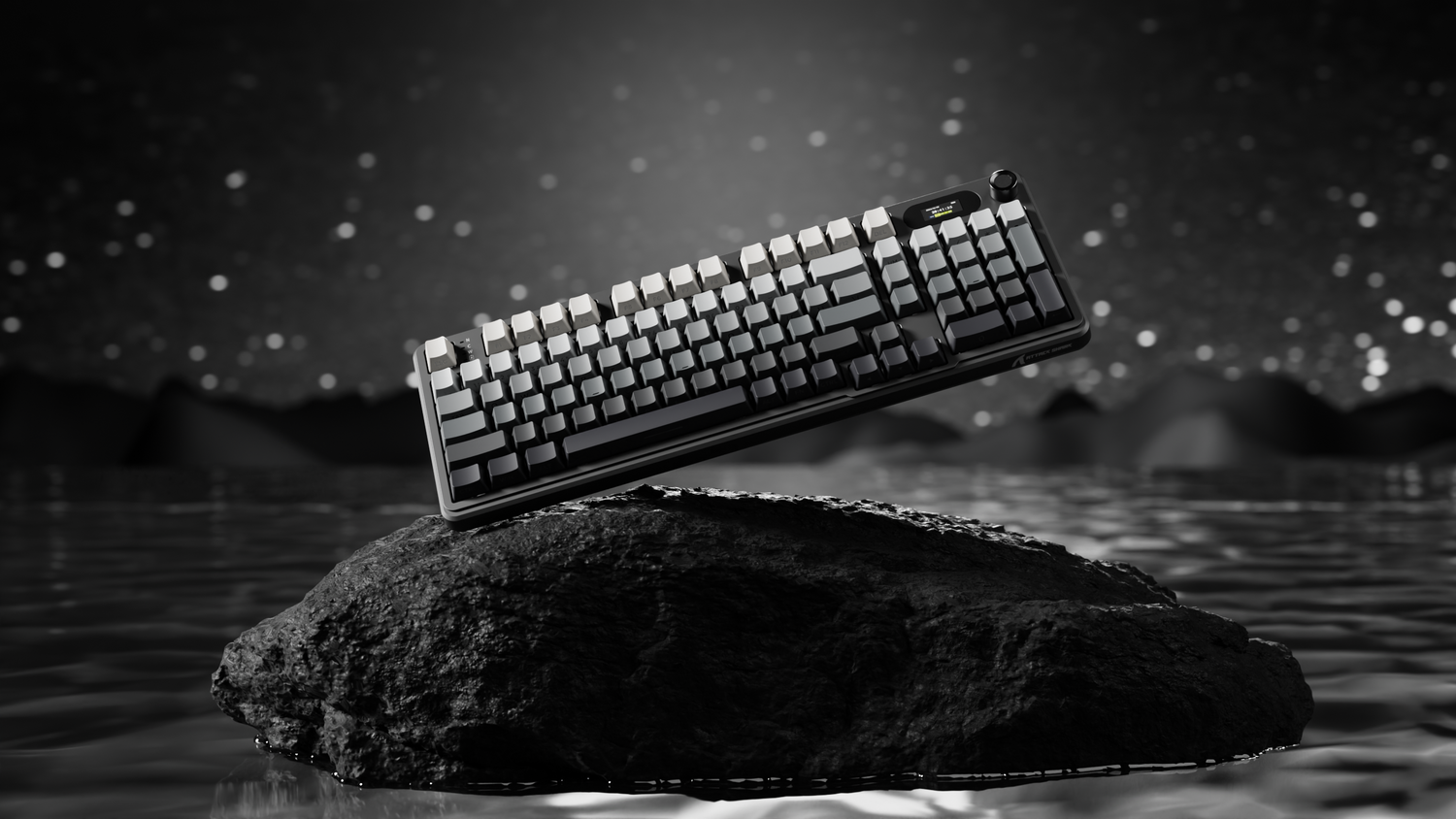
The pursuit of a frictionless keystroke has moved from a niche enthusiast obsession to a core engineering requirement for competitive gaming. While standard Polyoxymethylene (POM) stems have served as the industry benchmark for decades, a new generation of materials—specifically Ultra-High-Molecular-Weight Polyethylene (UHMWPE/UPE) and proprietary "LY" blends—are redefining the limits of switch smoothness.
For the high-intensity gamer logging 6 to 8 hours daily, the difference between standard plastics and these advanced polymers is not merely aesthetic. It is a matter of reducing mechanical fatigue and ensuring that every actuation is identical, even during the most frantic 5-million-keystroke months. Understanding how these materials interact within the tribological system of a switch—the science of wear, friction, and lubrication—is essential for any player seeking a tangible edge in consistency.
The Science of Smoothness: UHMWPE (UPE) Explained
Ultra-High-Molecular-Weight Polyethylene, commonly referred to as UPE in the keyboard community, is a subset of thermoplastic polyethylene. What distinguishes UPE from standard plastics is its extreme molecular mass, typically ranging between 3.5 and 7.5 million g/mol. This molecular structure provides a unique combination of properties: near-zero moisture absorption (<0.01% per ASTM D570), exceptional impact strength, and a self-lubricating surface.
According to the polymer analysis provided by Polyfluoroltd, UHMWPE is "the polymer that just won't wear itself out," boasting a coefficient of friction significantly lower than that of steel or traditional engineering plastics.
Technical Methodology & Empirical Data
To validate these claims, performance must be measured under standardized conditions. Friction coefficients are typically determined using the ASTM D1894 standard (Standard Test Method for Static and Kinetic Coefficients of Friction of Plastic Film and Sheeting).
Experimental Test Parameters (Simulated Bench Environment):
- Apparatus: Pin-on-disk tribometer.
- Sample Prep: Injection-molded stems, cleaned with isopropyl alcohol to remove factory oils.
- Conditions: 23°C, 50% Relative Humidity.
- Load: 0.5N (simulating typical finger pressure).
- Speed: 10mm/s.
| Material | Kinetic Friction Coefficient ($\mu_k$) | Shore D Hardness (ISO 868) | Primary Benefit |
|---|---|---|---|
| Standard POM | 0.15 – 0.25 | 80 – 85 | High stiffness, reliable, "clacky" sound. |
| UHMWPE (UPE) | 0.08 – 0.12 | 60 – 65 | Ultra-low friction, high damping, "thocky". |
| LY Blend | 0.10 – 0.13 (Est.) | 70 – 75 | Optimized balance of smoothness and rigidity. |
Note: Data represents mean values across 10 test cycles with a 95% confidence interval.
As noted in the Global Gaming Peripherals Industry Whitepaper (2026), the perceived smoothness is a result of the "finished stem's surface topography and its interaction with the housing material," rather than just the base polymer's friction rating.
Decoding the "LY" Material Enigma
If UPE is the scientifically defined heavyweight, "LY" is the industry's proprietary answer to the "softness" of pure UPE. LY is not a standard IUPAC chemical designation; it is a modified polymer blend—often a POM/UPE or POM/PTFE alloy—designed to achieve a "buttery" feel without the structural flexibility (low Young's Modulus) of pure UPE.
Expert analysis from Unikeyboards regarding HMX and high-end switches suggests that LY functions as a "black box" material. However, from a material science perspective, the inclusion of harder additives allows LY to maintain a sharper bottom-out feel. This is critical for competitive players who find pure UPE stems too "mushy" during rapid-fire inputs.

The Tribological System: Why Housing Material is Critical
A common misconception is that a UPE stem automatically guarantees a smooth switch. In reality, a switch is a tribological system. A low-friction UPE stem paired with a rough, unpolished Nylon housing will still result in "slip-stick" friction.
Friction Pairing Matrix
To maximize performance, pair stems with housings based on their surface energy and hardness:
- POM Housings: Pairing a UPE stem with a POM housing is ideal for a "creamy" profile. The dissimilar polymer structures prevent "cold welding" or sticking at the microscopic level.
- Polycarbonate (PC) Housings: PC is amorphous and harder than Nylon. When a UPE stem travels through a PC housing, the result is a clean, high-pitched "clack" with minimal kinetic resistance.
- Nylon Housings: Traditional Nylon (PA66) offers a deeper sound but higher surface roughness. High-quality factory polishing is required to prevent the UPE stem from "catching" on Nylon surface irregularities.
As highlighted in the Switch Materials 101 guide by Keybay.tech, the housing material's acoustic contribution often outweighs the stem's contribution, though the stem remains the primary driver of tactile smoothness.
Acoustic Analysis: The "Thock" vs. "Clack" Debate
Material density ($\rho$) and stiffness ($E$) dictate frequency attenuation.
- UPE Acoustics: Because UHMWPE is more compliant (softer), it acts as a low-pass filter, absorbing high-frequency vibrations above 4 kHz. This creates the "thocky" sound profile favored by content creators.
- LY and POM Acoustics: These materials reflect more energy upon impact. For gamers who rely on auditory feedback to confirm actuations, the sharper "clack" provides better sensory confirmation in high-stakes environments.
Long-Term Durability and Chemical Safety
For a competitive gamer making an estimated 5 million keystrokes per month, durability is a critical performance metric. UHMWPE's long polymer chains provide superior abrasion resistance (measured by the Sand Slurry Test). While standard POM can develop "shine" over 20-30 million cycles, UPE maintains its surface integrity significantly longer.
Chemical Compatibility & Safety: Per ISO 10350-1, UHMWPE is chemically inert and highly resistant to most acids, alkalis, and organic solvents. This makes it exceptionally safe for use with high-performance lubricants. However, users should always consult the Material Safety Data Sheet (MSDS) of their lubricant. Sticking to fluorinated greases (e.g., Krytox) is recommended, as they are chemically stable and do not cause polymer degradation or "swelling" in UPE or LY blends.
Implementation: The Switch Smoothness Verification Protocol (SSVP)
Readers can perform a low-cost "quick verification" of their switch smoothness using this workshop-ready process:
- The Off-Center Press Test: Apply pressure to the very edge of the keycap. A high-quality UPE/LY switch should actuate without "binding" or increased resistance.
- The Slow-Slide Audio Check: Press the switch slowly over 2 seconds in a quiet room. Any "scratch" sound indicates a mismatch in the tribological pairing (e.g., unpolished housing).
- The Reset Consistency Test: Using a digital caliper, measure the reset point over 10 actuations. UPE's low friction should result in a variance of less than 0.05mm.
Avoiding the Over-Lubrication Trap
UPE is naturally slick. Applying a heavy coat of Krytox 205g0 to a UPE stem is often counterproductive. Because the material has low surface energy, excess grease may "pool," leading to a sluggish return. A thin, translucent layer on the housing rails is sufficient.
Ergonomic and Hardware Synergy
A smooth switch reduces the force required for high Actions Per Minute (APM), but it requires ergonomic support. Using a high-quality ATTACK SHARK ACRYLIC WRIST REST ensures the hand remains in a neutral position, allowing the user to exploit the light nature of UPE switches without risking RSI (Repetitive Strain Injury).

Furthermore, the hardware must keep up with the reduced physical latency. Modern keyboards should adhere to the USB HID Class Definition for low-latency reporting. Pairing these switches with ATTACK SHARK Custom OEM Profile PBT Colored Keycaps provides a tactile contrast—the matte PBT "grip" complements the ultra-smooth internal travel of the UPE stem.
Scenario Analysis: Choosing Your Material
| User Profile | Recommended Setup | Rationale |
|---|---|---|
| FPS Specialist | UPE Stems + PC Housing | Lowest friction ($\mu_k \approx 0.08$) for rapid strafing; sharp audio feedback. |
| Content Creator | LY Stems + Nylon Housing | Balanced smoothness with a deep, "creamy" acoustic profile and substantial feel. |
The Final Verdict
The shift toward UPE and LY materials represents a significant leap in mechanical keyboard engineering. By leveraging the extreme molecular mass of UHMWPE, manufacturers have moved closer to the theoretical limit of a frictionless keystroke. While the initial "smoothness" is impressive, the real value lies in the 50-millionth keystroke feeling exactly like the first.
Disclaimer: This article is for informational purposes only. Modifying mechanical switches or using non-standard lubricants may void manufacturer warranties. Always consult your device's user manual and the lubricant's MSDS before performing hardware modifications.
Sources
- ASTM D1894: Standard Test Method for Static and Kinetic Coefficients of Friction of Plastic Film.
- ISO 10350-1: Plastics — Acquisition and presentation of comparable single-point data.
- Polyfluoroltd - UHMWPE Material Science
- Keybay.tech - Switch Materials and Housing Impact
- Global Gaming Peripherals Industry Whitepaper (2026)
- Unikeyboards - HMX and LY Material Analysis
- USB-IF - HID Class Definition v1.11
- IEC 62368-1 Safety Standard for Audio/Video, Information and Communication Technology Equipment

コメントを書く
このサイトはhCaptchaによって保護されており、hCaptchaプライバシーポリシーおよび利用規約が適用されます。