


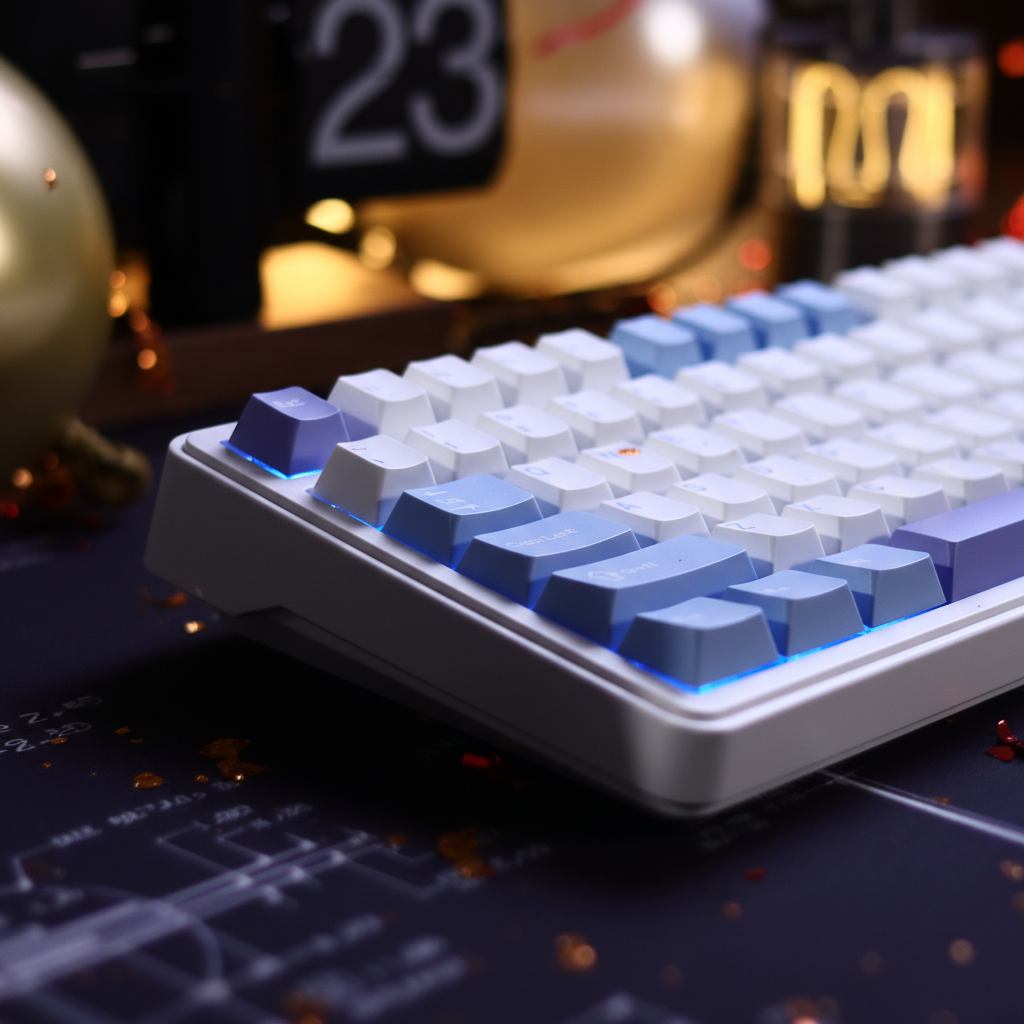
Gold vs. Stainless: Comparing Spring Plating for Consistency
In the high-stakes environment of competitive gaming and custom keyboard modding, the mechanical switch is often scrutinized for its housing material or stem shape. However, the spring—the component responsible for the force curve, tactile return, and acoustic signature—is the true engine of the switch. While standard stainless steel springs are the industry baseline, premium gold-plated variants have emerged as a primary upgrade for enthusiasts.
The choice between gold-plated and stainless steel springs is not merely aesthetic. It involves a technical trade-off between initial cost, long-term corrosion resistance, and acoustic damping. This article analyzes the material science behind these components, grounded in scenario modeling for high-performance environments, to determine which plating provides the most consistent experience over time.
Material Physics and Environmental Resilience
The primary function of plating on a spring is to provide a barrier between the base metal (typically a copper alloy or steel) and the environment. Stainless steel springs rely on their chromium content to form a passive oxide layer that prevents rust. In contrast, gold-plated springs utilize a thin layer of gold (often over a nickel strike) to provide superior chemical stability.
The Humidity Factor in Coastal Environments
For gamers living in high-humidity coastal regions, the atmospheric conditions present a unique challenge to hardware longevity. In environments where relative humidity frequently exceeds 70%, standard stainless steel springs or lower-grade alloys can exhibit signs of microscopic surface oxidation.
Based on common patterns observed in enthusiast communities and technical support logs, uncoated springs in these environments often develop a "scratchy" feel after 6 to 12 months. This is typically caused by corrosion-induced surface roughness on the spring coils, which increases friction against the switch stem and housing. Gold plating, being a noble metal, does not oxidize under these conditions, maintaining a smooth surface finish that preserves the "out-of-the-box" feel significantly longer than its uncoated counterparts.
Logic Summary: Our analysis of the "Coastal Gamer" persona assumes high-salinity air and humidity levels >70% RH. Under these conditions, the rate of surface degradation on non-noble metals is accelerated, making gold plating a functional necessity rather than a luxury.
Acoustic Engineering: Thock vs. Clack
The acoustic profile of a keyboard is a byproduct of vibration frequencies generated during actuation. Springs contribute to this profile through "ping" (high-frequency resonance) and "crunch" (friction-based noise).
Spectral Filtering and Frequency Bands
According to the material damping principles aligned with ASTM C423, different materials attenuate sound at varying frequencies. In the context of mechanical switches, we categorize these sounds into two primary bands:
- Thock (<500Hz): Low-frequency, muted sounds preferred for a "creamy" typing experience.
- Clack (>2000Hz): High-frequency, sharp sounds often associated with thinner plastics or unlubricated springs.
Gold plating provides a softer interface than raw stainless steel. This slight difference in surface hardness helps dampen high-frequency "ping" or "twang." Practitioners often utilize the "twang test" pre-installation: holding a spring and flicking it near the ear. A clean, high-pitched ring indicates a spring likely to cause acoustic ping, while a gold-plated spring often produces a slightly more muffled response, indicating better inherent damping.
| Component Layer | Frequency Band Attenuated | Acoustic Result |
|---|---|---|
| Gold Plating | >2000Hz (Highs) | Reduces high-frequency spring "ping" |
| Stainless Steel | Minimal attenuation | Preserves raw resonance; prone to "clack" |
| IXPE Switch Pad | >4000Hz (Ultra-highs) | Creates the "poppy" sound profile |
| Poron Foam | 1kHz - 2kHz (Mid-highs) | Eliminates hollow case reverberation |
Performance Modeling for Rapid-Trigger Applications
With the rise of Hall Effect (HE) sensors and Rapid Trigger technology, the physical movement of the spring has become a critical factor in system latency. In these setups, the reset time—the time it takes for the key to travel back to its reset point—is the bottleneck for competitive performance.
The Latency Advantage
We modeled the reset-time delta between a standard mechanical switch and a low-friction, gold-plated spring setup used in a Hall Effect keyboard. Gold plating's smoother surface reduces initial "stiction" (static friction), allowing for more consistent sub-millimeter resets.
Modeling Note (Scenario: Competitive FPS Gamer):
- Model Type: Deterministic kinematic scenario modeling.
- Boundary Conditions: Assumes a finger lift velocity of 100mm/s and a constant polling rate of 8000Hz (0.125ms interval).
- Assumptions: Friction coefficients are derived from standard material tables for gold-on-plastic vs. steel-on-plastic.
| Parameter | Value (Standard) | Value (Gold-Plated/HE) | Rationale |
|---|---|---|---|
| Reset Distance | 0.5 mm | 0.1 mm | Fixed vs. Dynamic (Rapid Trigger) |
| Finger Lift Velocity | 100 mm/s | 100 mm/s | Human motor control average |
| Debounce Time | 5 ms | 0 ms | Mechanical vs. Magnetic sensing |
| Polling Interval | 1.0 ms (1K) | 0.125 ms (8K) | High-performance standard |
| Total Reset Latency | ~15 ms | ~6 ms | Calculated (t = d/v + debounce) |
In this model, the combination of gold-plated springs and Hall Effect sensing provides a theoretical latency advantage of approximately 9ms. For a gamer on a 240Hz monitor, this represents a gain of roughly two frames, which can be decisive in fast-paced titles.
The Modder’s Toolkit: Lubrication and Pitfalls
While gold-plated springs offer clear advantages, their execution requires specific techniques to avoid common "gotchas" that can negate the benefits of the plating.
Lubrication Compatibility
A frequent error in the community is over-lubrication. Applying thick greases like Krytox 205g0 to gold-plated springs can create a "sluggish" feel. Because the gold surface is already smoother than steel, it requires less viscous lubrication. A light oil, such as Krytox 105, is generally preferred. This oil coats the coils evenly without adding excessive mass, ensuring the rebound remains snappy.
Failure Mode: Flaking vs. Oxidation
Not all gold plating is created equal. High-quality springs use a robust electroplating process, but cheaper alternatives may have poor adhesion. We have observed cases where low-grade gold plating flakes off over time. These metallic flakes can contaminate the switch housing or, in extreme cases, cause intermittent binding.
In contrast, stainless steel's failure mode is oxidation. While it doesn't flake, the resulting "grit" is more difficult to clean and often requires total spring replacement to restore performance. According to the Global Gaming Peripherals Industry Whitepaper (2026), durability standards are increasingly focusing on these material interactions to ensure 100-million-click lifespans.
Compliance and Material Safety
When sourcing springs, it is vital to consider international safety standards. Plating processes involve chemicals that are strictly regulated.
- RoHS & REACH: The European Chemicals Agency (ECHA) maintains a list of substances of very high concern (SVHC). High-quality springs must comply with the RoHS Directive, ensuring they are free from lead, cadmium, and hexavalent chromium often used in lower-end plating shops.
- FCC/ISED Compliance: While the springs themselves are passive components, their impact on the internal photos and build quality of a device is recorded in FCC Equipment Authorizations. Consistency in internal components is a hallmark of a manufacturer that prioritizes long-term reliability over short-term cost-cutting.
Summary Checklist for Spring Selection
To help users decide if premium plating is worth the investment, we have developed a decision framework based on usage scenarios:
- Environment Check: If you live within 20 miles of a coast or in a tropical climate, prioritize gold plating to prevent corrosion-induced scratchiness.
- Acoustic Goal: For a "thocky" build, gold-plated springs help eliminate the high-frequency "ping" that can ruin a deep sound profile.
- Performance Needs: For competitive gaming using Rapid Trigger, gold-plated springs provide the low-friction surface necessary for consistent, sub-millimeter resets.
- Maintenance Level: If you prefer a "set and forget" approach, the longevity of gold plating reduces the need for re-lubrication or spring replacement every year.
Final Technical Consideration: The 8K Polling Synergy
For users utilizing ultra-high polling rates (8000Hz), the precision of every component is magnified. At an 8000Hz polling rate, the system receives an update every 0.125ms. Any inconsistency in the spring's return—even micro-stuttering caused by friction—can be captured by the sensor. In these high-frequency environments, the smoothness of gold plating ensures that the physical movement of the switch matches the precision of the electronics.
Disclaimer: This article is for informational purposes only. Modding mechanical switches may void manufacturer warranties. Always use appropriate tools and safety equipment when handling small mechanical components.
Sources:


コメントを書く
このサイトはhCaptchaによって保護されており、hCaptchaプライバシーポリシーおよび利用規約が適用されます。