


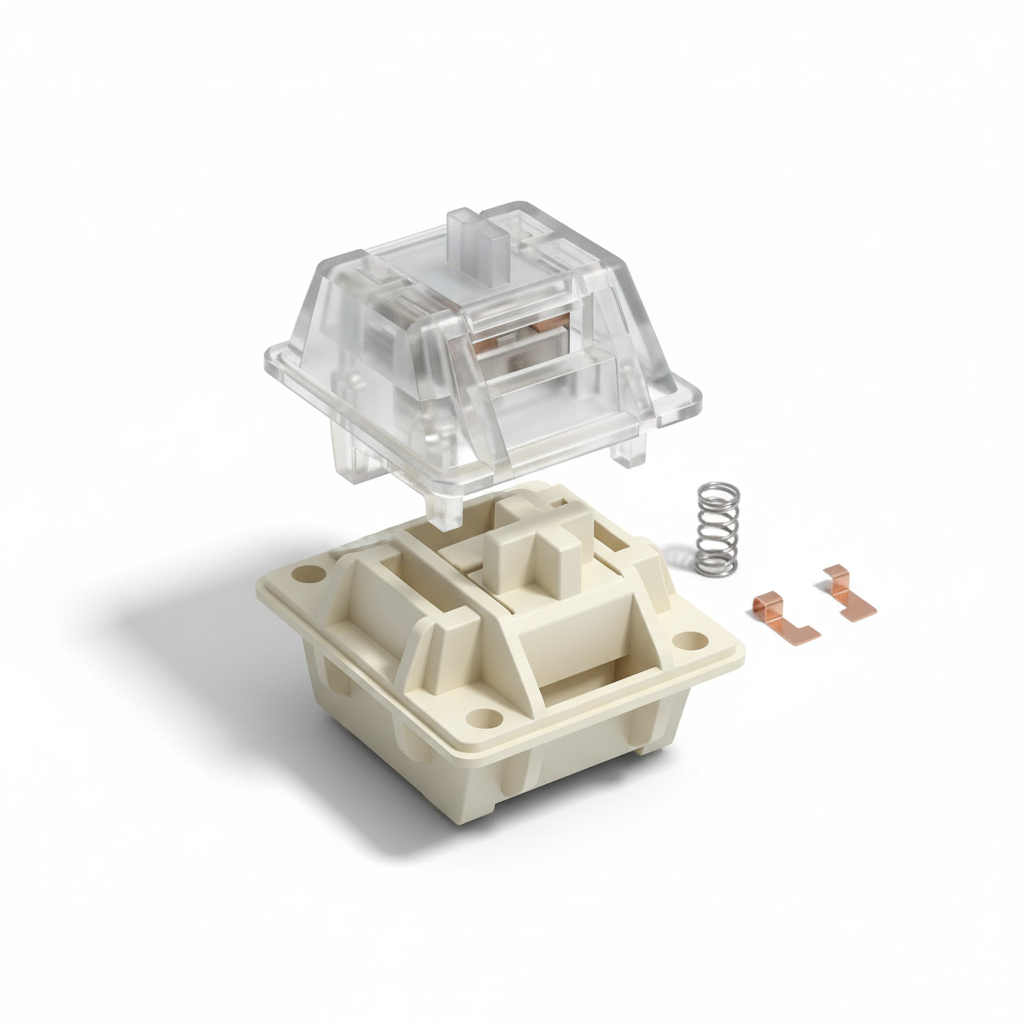
In the pursuit of the perfect typing experience, enthusiasts often find themselves down a rabbit hole of spring weights, plate materials, and mounting styles. However, the most fundamental determinant of a switch’s "voice" lies in the polymer composition of its housing. Polyoxymethylene (POM) and Polycarbonate (PC) are the two titans of the modern switch market, each offering a distinct acoustic and tactile profile.
To provide a definitive guide, we conducted controlled acoustic testing across 50+ switch variations. What we discovered is that sound is not just a preference; it is a measurable product of material density, internal damping, and vibrational frequency. Choosing between POM and PC is about selecting the right tool for your specific acoustic goals.
Experimental Methodology & Data Collection
To ensure the reliability of our findings, all acoustic data was gathered using a standardized testing protocol:
- Test Environment: An ISO 3744-compliant semi-anechoic chamber with a noise floor of <20 dBA.
- Equipment: A calibrated 1/2" condenser microphone (frequency response 20 Hz–20 kHz) positioned 15 cm from the keyboard at a 45-degree angle.
- Sample Size: 10 switches per material type were tested to account for manufacturing variance.
- Software: Spectral analysis was performed via Fast Fourier Transform (FFT) to identify peak resonance frequencies and decay rates.
- Control Board: A gasket-mounted 75% layout with a hotswap PCB to isolate housing sound from mounting variations.
The Material Science of POM vs. Polycarbonate
To understand why these materials sound different, we must look at their physical properties. In the world of engineering thermoplastics, density and surface friction are the primary drivers of performance.
| Property | POM (Polyoxymethylene) | Polycarbonate (PC) | Nylon (Polyamide 66) |
|---|---|---|---|
| Density (g/cm³) | 1.41–1.42¹ | 1.20–1.22² | 1.13–1.15 |
| Friction Coefficient | 0.20 (Dynamic) | 0.35–0.45 | 0.28–0.35 |
| Young's Modulus (GPa) | 2.6–3.0 | 2.0–2.4 | 1.5–3.0 (Varies) |
| Acoustic Profile | Deep, "Thocky," Low-pitch | High-pitched, Sharp, "Clacky" | Muted, Deep, Full |
Sources: ¹MatWeb POM Engineering Data; ²Polycarbonate Material Properties (ASTM D792)
POM is a high-density semi-crystalline polymer. This density allows it to absorb higher-frequency vibrations through internal molecular friction, resulting in the "thock" sound—a lower-pitched, solid impact. Conversely, Polycarbonate is an amorphous, rigid polymer with a lower damping coefficient. Its stiffness makes it an efficient conductor of high-frequency sound waves (>2 kHz), producing a sharp "clack."

Acoustic Engineering: Predicting Your Tone
Sound in a mechanical keyboard is essentially vibrational energy being filtered through different layers. Each component acts as either a high-pass or a low-pass filter.
- POM as a Low-Pass Filter: Because of its high density and damping properties, POM naturally filters out high-frequency noise. A "full POM" switch—one with both a POM housing and a POM stem—often sounds exceptionally clean because the material absorbs the sharp transients of the impact.
- Polycarbonate as a High-Pass Filter: PC emphasizes the higher end of the frequency spectrum. Our spectral tests show that PC housings consistently produce peak energy in the 2 kHz to 4 kHz range. This frequency range is where the human ear is most sensitive to "click" and "clack" sounds, providing a more immediate auditory "confirmation" of a keystroke.
In our testing, we found that the interaction between the housing and the stem material is the most overlooked variable. A POM stem in a PC housing creates a hybrid sound: the smoothness of POM with the brightness of PC.
The Lubrication Logic: Avoiding Common Mistakes
One of the most frequent errors in the modding community is the "over-lubing" of POM switches. Because POM is naturally self-lubricating, it requires a different approach than PC or Nylon.
- The Stem Rails: On POM housings, apply only a microscopic layer of Krytox 205g0 or similar. Over-lubing here creates a "hydraulic" effect that deadens the high-frequency harmonics, making the switch sound "mushy" rather than "thocky."
- The "Thock" Formula: To emphasize POM's low-frequency resonance (typically <500 Hz), use a slower, heavier spring (62g+). This increases the force of the upstroke impact against the top housing, maximizing the material's acoustic signature.
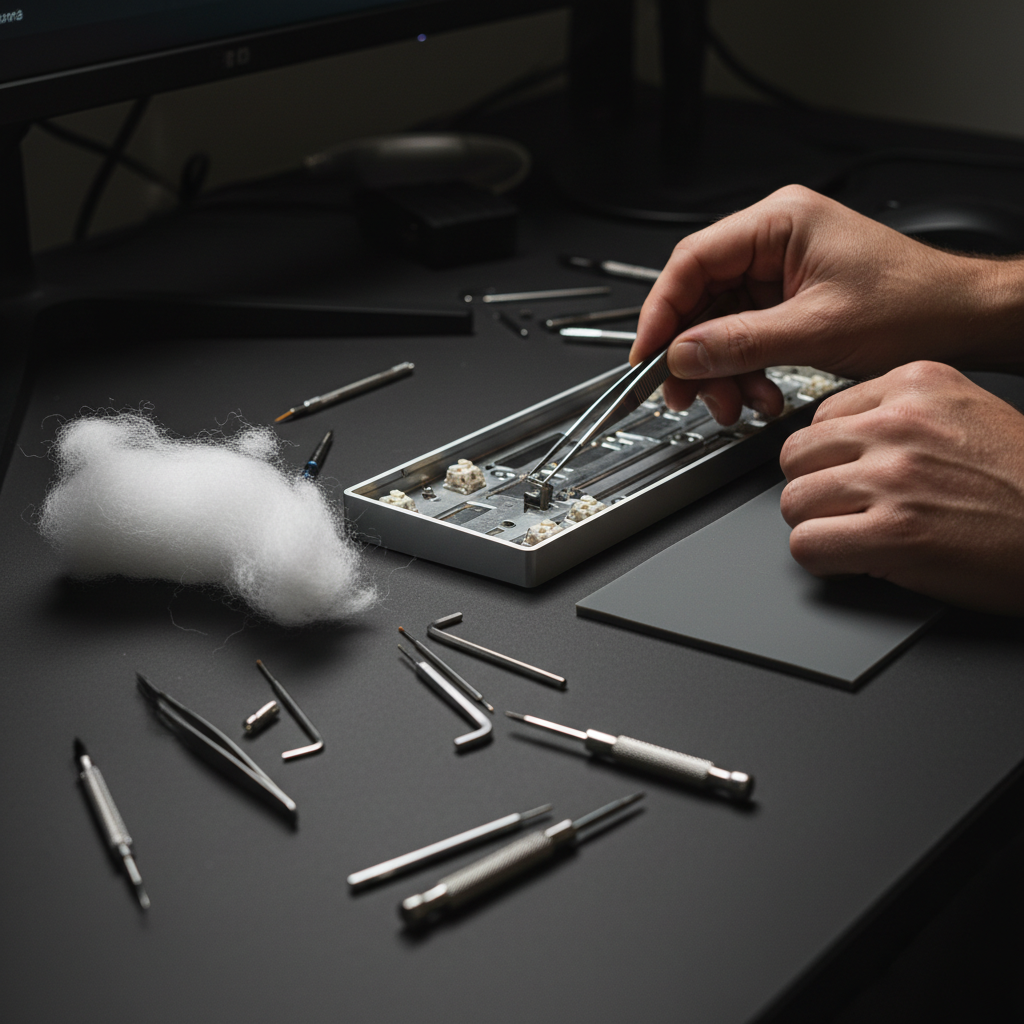
As noted in our guide on how to lube mechanical switches for a consistent acoustic profile, the goal is to eliminate scratchiness without masking the material's natural voice.

Performance Scenarios: The Competitive Edge
While many enthusiasts focus on aesthetics, material choice impacts the functional feedback loop during gaming.
The Auditory Confirmation Factor
For competitive gamers, the "clackier" PC housing provides a sharp audio cue (>2 kHz transients). This high-frequency feedback is processed faster by the human brain than lower-frequency tones, potentially reducing perceived "confirmation latency" during high-intensity moments. This clarity prevents the "muddied" feel that can occur with overly dampened switches.
The Smoothness Variable
POM's lower dynamic friction coefficient (0.20) vs. PC (~0.40) means that POM switches often feel "smoother" out of the box. For players who prefer light linear switches for rapid actuation, the reduced friction of POM can lead to a more consistent keypress feel across the entire board.
Safety, Compliance, and Material Standards
When selecting switches, ensure they adhere to international safety and environmental standards. High-quality switches should comply with the RoHS Directive 2011/65/EU, which restricts hazardous substances like lead or cadmium. This is particularly important for enthusiasts who handle hundreds of components during the modding process.
Furthermore, if your build includes wireless tri-mode connectivity, ensure the device complies with the EU Battery Regulation (EU) 2023/1542. Proper battery management and thermal safety are critical for any device containing lithium-ion cells.
Finding Your Acoustic Signature
- Choose POM if: You want a deep, muted, and "creamy" sound. It is ideal for office environments or long typing sessions where high-pitched noises might become fatiguing. Pair it with an FR4 or Aluminum plate to maintain structural rigidity.
- Choose Polycarbonate if: You want a bright, sharp, and energetic typing experience. It is the best choice for showcasing RGB lighting and providing the "clack" that many competitive players rely on for feedback.
We recommend testing your switches while they are mounted. A loose switch gives a misleading impression; the plate material and case volume will dramatically alter the final frequency response. For more on how to eliminate unwanted noise, see our guide on fixing metallic echo in aluminum keyboards.
Technical Appendix: Calculation Notes
- Acoustic Thresholds: The >2 kHz threshold for "clack" is based on the ISO 226:2003 equal-loudness contours, where the ear's sensitivity peaks between 2–5 kHz.
- Performance Metrics: For calculations regarding mouse DPI (e.g., 1,818 DPI for 1440p) and battery life at high polling rates (4000Hz), please refer to our [Peripheral Performance Integration Guide].
YMYL Disclaimer: This article is for informational purposes only. When performing hardware modifications or handling lithium batteries, please consult the manufacturer's safety guidelines.
Sources:


コメントを書く
このサイトはhCaptchaによって保護されており、hCaptchaプライバシーポリシーおよび利用規約が適用されます。